
Minto Pyramid Principle

Minto Pyramid Principle: this article offers a practical explanation of the Minto Pyramid Principle, developed by Barbara Minto. Next to what it is (the basics), this article also highlights the structure and it’s applicability. Also the advanatges and disadvantegs of the this principle are being discussed. Enjoy reading!
What is the Minto Pyramid Principle? The basics
Minto Pyramid Principle, also referred to as the McKinsey’s Pyramid Principle, is a tool used to process and structure large amounts of information to convey a story, message or presentation without omitting important details.
The principle of the McKinsey Pyramid is to cut to the chase in written texts or presentations. This ensures that the audience’s attention is captured and that a riveting story can be created that’s easy to remember and understand.

The Minto Pyramid Principle is applied by structuring points and arguments after the thesis statement has been introduced. The information that is presented subsequently branches off to the specific details in a clear and insightful manner.
‘The Pyramid Principle’, a book written by Barbara Minto, was published in the 1970s by McKinsey & Company. Barbara Minto was responsible for training new recruits into becoming expert consultants in the shortest possible time.
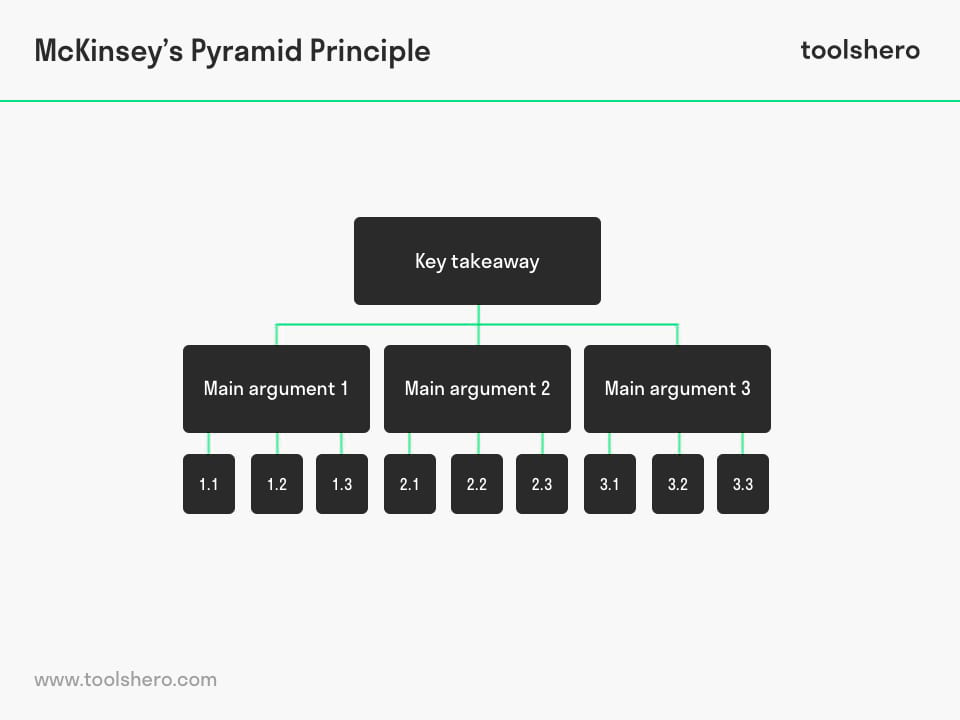
Figure 1 – the Minto Pyramid Principle
Structure
Writing texts, giving presentations or making recommendations based on the Minto Pyramid Principle is done by applying the following three levels of the pyramid:
1. Start with the answer, thesis or key point
Applying the top-down structure of a pyramid in communication methods means that a direct answer is given to the question that has been asked. These could also be recommendations, the results from a study, thesis statement or other key points.
Minto Pyramid Principle inverts the traditional method that’s used to arrive at a conclusion. Usually, the conclusion in a text or presentation is given after the facts have been presented, and all analyses and supporting ideas have been discussed.
With her Pyramid Principle, Barbara Minto explains why the answer is first given in a clear and concrete form. Only then must the supporting reasons or motivations be given. The first reason for this is to maximise and effectively use the limited time of the audience.
In most conversations with a supervisor, for instance, recommendations are made. The reason to first make the recommendation and then offer the motivation is that the supervisors often already see the conclusion or recommendation coming when a flood of arguments and reasons is provided. This because they think in such a top-down way, focusing on the bigger picture.
Moreover, a direct communication method is more convincing than a conversation that beats about the bush. A direct communication style is a display of assertiveness and self-confidence.
2. Group arguments and summarise the main points
Now that the key point has been laid down, the arguments, reasons or motivation for giving the presentation must be discussed.
According to the Minto Pyramid Principle, this level is about joining all arguments in main points. Each point represents a summary of specific support for the recommendation or the answer from the first step.
3. Present supporting details and ideas in a logical manner
Subsequently, the pyramid branches out from each argument to the lowest level where supporting details and ideas are given that must show the validity of the presented arguments. The whole of these three levels forms the pyramid structure.
Always first give the summarising idea, on the top of the pyramid. Clarity and logic can be applied in the story by paying attention to the structure and order.
If the arguments and ideas that are given contain a certain flow, frequency or cause-effect structure, these must be placed in chronological order. It’s also recommended to first present the most important arguments and ideas.
Minto Pyramid Principle and it’s applicability
It’s not surprising that the pyramid principle arose in the organisational consulting branch. That’s exactly where larger and more complex writing tasks is the order of the day. By structuring texts by means of the Minto Pyramid Principle, the texts are shortened, become clearer and are easier to follow.
This also has a great advantage for the writer himself. By thinking about the cohesion between ideas beforehand, these can be put to paper more efficiently and the main and auxiliary matters can more easily be distinguished.
Facts and thoughts are organised in a way that makes the text more convincing. Moreover, training with such a structure also has the benefit of the person choosing his words more carefully in everyday life, including on the work floor.
By removing all irrelevant matters, the core takes front and centre and the user increases the potential to climb up the hierarchy.
Advantages and disadvantages in using the Minto Pyramid Principle
According to Barbara Minto, using the Minto Pyramid Principle offers several advantages compared to other writing structures:
- More efficient writing because thoughts and ideas are organised in advance
- It helps the reader because reading strategies have been incorporated into the text itself
- Consistent quality
- Greater persuasion
- The Minto Pyramid Principle matches the way the human brain works
However, there are also disadvantages concerned with the use of the Minto Pyramid Principle:
- The tool demands a lot of training to create better texts
- There is a danger of repeating information
- And this makes it difficult to formulate an insightful synthesis
- Minto Pyramid Principle is mainly effective for texts with an unambiguous conclusion or recommendation, and not for other types of texts

Now it’s your turn
What do you think? Do you recognise the explanation of the Minto Pyramid Principle? Will you apply this communication tool in your work and private life? What do you believe are factors that contribute to an effective communication style?
Share your experience and knowledge in the comments box below.
More information
- Minto, B. (2009). The pyramid principle: logic in writing and thinking. Pearson Education.
- Locker, K. O., & Kaczmarek, S. K. (2009). Business communication: Building critical skills. New York, NY: McGraw-Hill Higher Education.
How to cite this article:
Janse, B. (2018). Minto Pyramid Principle. Retrieved [insert date] from Toolshero: https://www.toolshero.com/communication-methods/minto-pyramid-principle/
Published on: 01/16/2018 | Last update: 08/20/2023
Add a link to this page on your website:
<a href=”https://www.toolshero.com/communication-methods/minto-pyramid-principle/”>Minto Pyramid Principle</a>

Ben Janse
Ben Janse is a young professional working at ToolsHero as Content Manager. He is also an International Business student at Rotterdam Business School where he focusses on analyzing and developing management models. Thanks to his theoretical and practical knowledge, he knows how to distinguish main- and side issues and to make the essence of each article clearly visible.

Related ARTICLES

Ladder of Abstraction (Hayakawa)


7 C’s of Communication Theory

Five Canons of Rhetoric (Aristotle)

Rose of Leary model explained








2 responses to “Minto Pyramid Principle”
Thank you for this interesting article! Maybe an example would explain better the advantage of this system.
Thank you for your comment and suggestion, Georges. An example would be a nice add-on in this article. I will discuss it with the author. Have a good day!