
Business Model Canvas (BMC) explained including template

Business model canvas - toolshero.com

The Business Model Canvas helps you quickly gain a clear understanding of how an organization creates, delivers, and captures value. This is useful when an idea still feels vague, a business model is unclear, or decisions are based too heavily on assumptions. Using the nine building blocks, you can clearly map out your customers, value proposition, channels, revenue streams, costs, partners, and activities side by side.

In this article, you’ll discover what the Business Model Canvas is, how Alexander Osterwalder and Yves Pigneur developed the BMC model, and how to practically fill in the nine building blocks. You’ll also get an example and a downloadable Business Model Canvas template so you can get started right away. Enjoy reading.

What is the Business Model Canvas (BMC)?

The Business Model Canvas (BMC) is a strategic tool for organizations. It is also known as the BMC model. It is a graphic representation of a number of building blocks that represent the elements of an organization.

The BMC can be deployed as a strategy tool for the development of a new organization and business model innovation. It can also be used to analyse the (business) situation of an existing business.

The Business Model Canvas was developed by the Swiss business model guru Alexander Osterwalder and management Information Systems professor Yves Pigneur. They defined nine categories for the BMC which they refer to as the building blocks of an organization.

The model was published in the book Business Model Generation (2010). The building block are:

  1. Key partners
  2. Key activities
  3. Key resources
  4. Value propositions
  5. Customer relationships
  6. Channels
  7. Customer segments
  8. Cost structure
  9. Revenue streams

The performance of an existing organization can easily be improved using the Business Model Canvas. All company aspects are made clear at a glance because of the visual aspect.

By looking at the developments per category, an organization can fine-tune its value proposition and structurally improve its strategy.

When setting up a new company clear decisions can be made in advance using the Business Model Canvas.
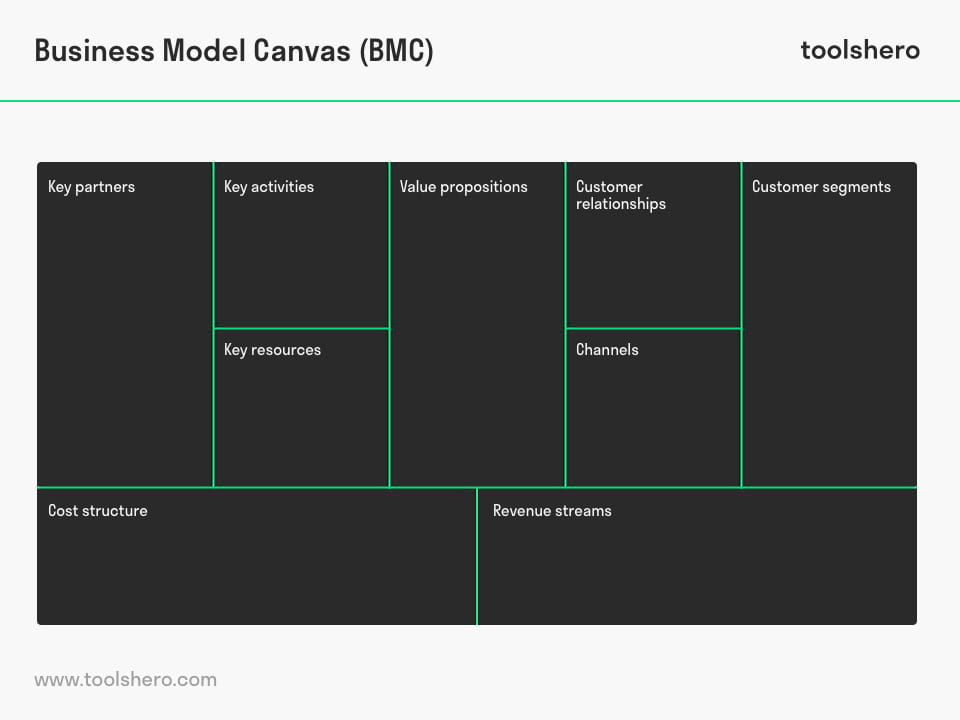
business model canvas bmc template - Toolshero

Figure 1 – Business Model Canvas (BMC)

1. Key partners

Key partnerships are placed on the left side of the canvas. For both start-up organizations and existing organizations it may be important to create alliances with partners. For instance when fighting the competition and combining knowledge and skillfulness.

Essential information will be acquired by knowing in advance which partners may constitute a valuable relationship.

2. Key activities

A good understanding of the value proposition can be obtained by having proper knowledge of the core activities of a company. This is not just about production. A problem-solving approach, networking and the quality of the product or service are important as well.

When the organization knows what the added value for the customer is, a better relationship may develop with existing customers. This may be helpful in the canvassing of new customers and makes it easier to keep the competition at bay.

3. Key resources

Resources are means that a company needs to perform. They can be categorized as physical, intellectual, financial or human resources.

Physical resources may include assets such as business equipment. Intellectual resources include among other things knowledge, brands and patents. The financial resources are related to funds flow and sources of income and human resources comprises the staffing aspect.

4. Value propositions

The value proposition is about the core of a company’s right to exist, it meets the customer’s need.

How does an organization distinguish itself from the competition? On the one hand, this distinction focuses on quantity such as price, service, speed and delivery conditions. On the other hand, it also focuses on quality including design, brand status and customer experience and satisfaction.

Tip: The Business Model Canvas helps organizations renew their value proposition. This is exactly what the Blue Ocean Strategy aims to achieve. Discover how you can use this strategy to create truly distinctive value outside existing markets.

5. Customer relationships

It is essential to interact with customers. The broader the customer base the more important it is to divide your customers into different target groups. Each customer group has specific needs.

By foreseeing the customer needs, the organization invests in different customers. A good service will ensure good and stable customer relationships that will be ensured in the future.

6. Channels

An organization deals with communications, distribution and sales channels. It is not just about customer contact and the way in which an organization communicates with their customers. The purchase location and the delivery of the product and/or services provided are decisive elements in this.

Channels to customers have five different stages: awareness of the product, purchase, delivery, evaluation & satisfaction and after sales. It is advisable to combine offline and online channels to reach as many customers as possible.

7. Customer segments

As organizations often provide services to more than one customer group, it is sensible to divide them into customer segments.

Products and services can be better geared towards specific needs and requirements for each group. This can be done by identifying what those needs are and which value is attached to them. This will lead to greater customer satisfaction, which in turn will contribute to a good value proposition.

8. Cost structure

By gaining an insight into cost structure, an organization will know what the minimum turnover must be to make a profit.

The cost structure considers economies of scale, constant and variable costs and profit advantages. Costs have to be adjusted when it’s obvious that more investments must be made than the organization is generating in revenue. Often an organization will opt for deleting a number of key resources.

9. Revenue streams

In addition to the cost structure, the revenue streams will provide a clear insight into the revenue model of an organization. For example, how many customers does an organization need on an annual basis to generate a profit? How much revenue does it need to break even?

The revenue streams are cost drivers. Aside from the sale of goods, subscription fees, lease income, licensing, sponsoring and advertising may also be an option.

Filling Out the Business Model Canvas: A Step-by-Step Guide

Filling out the Business Model Canvas helps to clarify an idea, organization, or revenue model. The nine building blocks are not separate from one another. Rather, they show how customers, value, activities, costs, and revenue are interconnected.

When filling it out, it’s helpful not to start directly at the top left, but to first consider the customer and the value the organization aims to deliver. After that, the internal activities, partners, resources, and costs become clearer.

Step 1: Identify the customer segments

Start by asking for whom the organization creates value. Are they consumers, businesses, students, professionals, specific industries, or multiple target groups?

Define the customer segments as specifically as possible. A broad target audience such as “everyone” is usually too general. The more precisely defined the customer segment, the better the value proposition, channels, and customer relationships can be developed.

Step 2: Formulate the value proposition

The value proposition describes which problem is solved or which need is met. This is one of the most important components of the Business Model Canvas.

Ask questions such as:

  • What problem is the customer facing?
  • What solution does the organization offer?
  • Why does the customer choose this solution over an alternative?
  • What specific benefits does the product or service provide?

A strong value proposition is clear, distinctive, and tied to a genuine customer need.

Step 3: Choose the Right Channels

Next, consider how the organization reaches its customers. This involves communication, sales, distribution, and delivery.

Examples of channels include a website, online store, social media, newsletter, sales team, partners, brick-and-mortar stores, events, or online platforms. It’s important that the chosen channels align with customer behavior.

Step 4: Develop customer relationships

Customer relationships refer to the way an organization maintains contact with its customers. This can be personal, automated, advisory, service-oriented, or community-driven.

Examples include customer service, onboarding, account management, self-service, loyalty programs, or personalized guidance. The right customer relationship helps build trust and retain customers for longer.

Step 5: Determine the revenue streams

Once it’s clear what value is being delivered, you can examine how the organization generates revenue. This reveals the revenue model.

Examples of revenue streams include one-time sales, subscriptions, licenses, rentals, service contracts, advertisements, commissions, or freemium models. Be sure to verify whether customers are actually willing to pay for the value offered.

Step 6: Describe the core activities

Core activities are the most important tasks required to deliver on the value proposition. Without these activities, the organization cannot fulfill its promise to the customer.

These include production, product development, marketing, sales, customer service, software development, logistics, knowledge sharing, or quality control. Select only the activities that are truly essential to the business model.

Step 7: Identify the key resources

Resources are the assets needed to make the business model work. These can be physical, financial, human, or intellectual resources.

Examples include employees, knowledge, technology, machinery, data, brand names, patents, software, capital, or a strong network. These resources support the core activities and enable the value proposition.

Step 8: Identify the key partners

Partners are external parties that help make the business model stronger, more efficient, or more scalable. These can include suppliers, technology partners, knowledge partners, distributors, investors, or strategic partners.

A good partner complements what the organization itself lacks, is unwilling to do, or cannot organize efficiently.

Step 9: Develop the cost structure

Finally, examine the key costs. This provides insight into what is needed to keep the business model running.

Consider personnel costs, marketing costs, software, production, distribution, facilities, procurement, maintenance, or external partners. Always compare the cost structure with the revenue streams. This will clarify whether the business model is financially viable.

Check the coherence between the building blocks

After completing the Business Model Canvas, it’s important to review the whole picture. Does the value proposition align with the chosen customer segments? Do the channels align with customer behavior? Do the revenue streams make sense in relation to the cost structure?

A Business Model Canvas is not a static document. It is a working model that can be regularly adjusted based on new insights, customer feedback, and changes in the market.

Business Model Canvas, Lean Canvas, and Value Proposition Canvas: What’s the Difference?

The Business Model Canvas is often compared to the Lean Canvas and the Value Proposition Canvas. The models are similar, but each has a different focus. The Business Model Canvas provides a comprehensive overview of the business model. The Lean Canvas focuses primarily on new ideas and assumptions. The Value Proposition Canvas delves deeper into the customer and the value proposition.

These models work well when used together. The Business Model Canvas helps you understand the big picture. The Value Proposition Canvas helps you gain a clearer understanding of what customers need. The Lean Canvas helps you test risks and assumptions more quickly.

Model
Focus
When to use?

Business Model Canvas
An organization’s complete business model
For strategy development, business model innovation, business plans, and improving existing organizations

Lean Canvas
Problems, solutions, risks, and assumptions surrounding a new idea
For startups, new products, innovative ideas, and situations where there is still a great deal of uncertainty

Value Proposition Canvas
The connection between customer needs and the value proposition
For product development, customer research, positioning, and refining customer value

Lean Canvas

The Lean Canvas focuses more on speed, experimentation, and uncertainty. While the Business Model Canvas takes a broad view of the organization, the Lean Canvas places greater emphasis on the problem, the solution, the target audience, the unique value proposition, and the key risks.

This model is often used by startups and for new ideas. It helps quickly identify assumptions. These assumptions can then be tested through customer interviews, prototypes, experiments, or market feedback.

Value Proposition Canvas

The Value Proposition Canvas delves deeper into two components of the Business Model Canvas: customer segments and the value proposition. The model helps to better understand which tasks, pain points, and benefits are important to the customer.

This canvas is particularly useful when an organization wants to verify whether its product or service truly meets the customer’s needs. It prevents an organization from thinking primarily in terms of its own offerings while customer demand remains insufficiently defined.

Which canvas should you choose?

Choosing the right canvas depends on the central question at hand. Do you want to map out the entire business model? Then the Business Model Canvas is the best choice. Do you want to quickly test a new idea? Then the Lean Canvas is a better fit. Do you primarily want to improve the value proposition? Then the Value Proposition Canvas offers more depth.

In practice, the models complement each other well. An organization can start with the Value Proposition Canvas to clarify customer needs. Afterward, the Business Model Canvas can be used to develop the full revenue model. When there’s a lot of uncertainty, the Lean Canvas can help test the most important assumptions more quickly.

The power of brainstorming sessions

All members of the management team can make excellent contributions to the business model canvas. This can be done by filling it out on a large sheet of paper.

This way, all members can enjoy brainstorming sessions with each other, think about the categories and voice their opinions. This will create a good and objective image of the organization. Any new ideas can be discussed immediately and possibly be developed concretely.

Business Model Canvas example
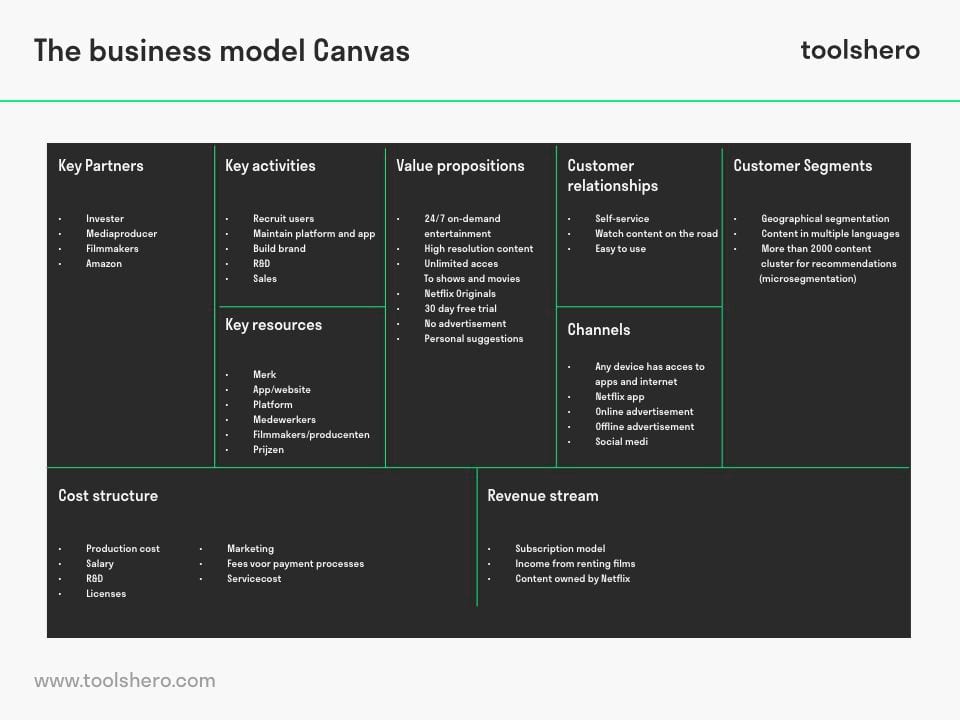
Business model canvas example - Toolshero

Figure 2 – a example of a filled Business Model Canvas

Business Model Canvas Template

Start describing the different aspects of the Business Model Canvas with this ready to use BMC template.

Download

Download the Business Model Canvas Template

For members only | Get instant access to the Business Model Canvas Template — plus unlimited access to 1,200+ expert articles and tools. Explore Membership Options

Advantages and Disadvantages of the Business Model Canvas

The Business Model Canvas has several advantages, but also some limitations. The model primarily helps you quickly get an overview. At the same time, it remains important to validate assumptions with research, data, and real-world feedback.

Advantages of the Business Model Canvas

A key advantage of the Business Model Canvas is that it presents the business model in a visual and organized way. The nine building blocks show, in a single diagram, how an organization creates value, delivers it, and converts it into revenue.

In addition, the canvas helps facilitate faster discussions about strategy, customers, costs, and revenue models. This makes the model well-suited for brainstorming sessions, management meetings, innovation projects, and developing new ideas.

Other benefits include:

  • the model makes complex business information easier to understand;
  • the relationships between customer segments, value propositions, channels, and revenue become clear;
  • the canvas encourages teams to take a critical look at the existing business model;
  • new ideas can be quickly developed and discussed;
  • the model is useful for startups, existing organizations, nonprofits, and project teams;
  • the canvas helps identify assumptions, opportunities, and areas for improvement more quickly.

Disadvantages of the Business Model Canvas

One disadvantage of the Business Model Canvas is that the model sometimes seems too simplistic. Filling in the nine building blocks does not automatically mean that the business model will work. That requires customer research, financial justification, and market validation.

The canvas primarily provides an overview. It is not a complete business plan, market research, or financial analysis. Organizations must therefore avoid viewing the model as a final result. Rather, it is a starting point for further exploring and testing options.

Possible drawbacks include:

  • the canvas may be filled out too superficially if little customer information is available;
  • important assumptions sometimes remain untested;
  • financial feasibility is not thoroughly analyzed;
  • external factors such as competition, legislation, and market developments receive little attention;
  • the model is a snapshot and must be updated regularly;
  • Without proper guidance, a brainstorming session may remain too general.

How can you get more out of the Business Model Canvas?

The Business Model Canvas delivers the most value when used as a working document. Don’t just fill out the canvas once and then set it aside. Instead, use it to discuss ideas, test assumptions, and refine decisions.

Ideally, combine the canvas with customer interviews, market research, financial calculations, and experiments. This not only creates a clear business model but also a better-substantiated strategy.

Common Mistakes When Filling Out the Business Model Canvas

Filling out the Business Model Canvas seems simple, but in practice, assumptions are often made too quickly. This results in a canvas that looks complete but isn’t yet sufficiently substantiated. By recognizing common mistakes, the model becomes stronger and more applicable.

1. Defining customer segments too broadly

A common mistake is choosing a target audience that’s too broad. A customer segment such as “businesses,” “consumers,” or “everyone” provides little direction. This makes it difficult to define a clear value proposition, appropriate channels, and strong customer relationships.

Therefore, make customer segments specific. Consider customer type, industry, needs, behavior, purchase motivation, or problem. The clearer the customer segment, the easier it is to fill out the rest of the canvas.

2. Keeping the value proposition too general

The value proposition is often too vague. Words like “quality,” “service,” or “customization” only mean something when it’s clear what problem they solve.

A strong value proposition specifies what the customer receives, why it is valuable, and how the organization stands out. Therefore, always link the value proposition to a clear customer need.

3. Not testing assumptions

A Business Model Canvas often contains many assumptions at the outset. That’s not a problem, as long as these assumptions are verified later. A mistake occurs when ideas are treated as facts right away.

Test assumptions through customer interviews, market research, experiments, prototypes, or sales data. This will reveal whether customers recognize the problem, understand the solution, and are willing to pay for it.

4. Overestimating Revenue Streams

Revenue streams are sometimes projected too optimistically. These projections assume a large customer base, rapid growth, or a high willingness to pay, without any substantiation.

Therefore, clearly define how revenue is generated. Consider sales, subscriptions, licenses, commissions, service contracts, or advertising. Also verify that the expected revenue aligns with customer behavior and needs.

5. Underestimating the cost structure

Another risk is that costs are viewed too narrowly. In addition to direct costs, there are often costs associated with marketing, personnel, software, distribution, customer service, administration, maintenance, and external partners.

A realistic cost structure helps assess whether the business model is feasible. Therefore, always compare costs with revenue streams and the scale at which the organization intends to operate.

6. Involving partners too soon or too late

Some organizations include too many partners in the canvas, even though it’s not yet clear what value they add. Other organizations, on the other hand, overlook which external parties are necessary for the business model to function properly.

Therefore, take a critical look at your partners. What knowledge, resources, access to customers, or economies of scale do they bring to the table? A partner should strengthen, simplify, or accelerate the business model.

7. Using the canvas as a final document

The Business Model Canvas is not a final document, but a working model. It’s a mistake to fill out the canvas once and then never update it.

Markets change, customer needs evolve, and new insights often emerge only after implementation. Therefore, revisit the canvas regularly. This ensures the business model remains up-to-date and useful.

8. Check for insufficient alignment between the building blocks

The nine building blocks must align with one another. A strong value proposition has little effect if the chosen channels do not reach the customer. An attractive revenue model does not work if the cost structure is too burdensome.

Therefore, always check for coherence. Does the target audience align with the value proposition? Do the channels align with customer behavior? Do the key activities and resources support the promise to the customer? And is the whole thing financially feasible?

By avoiding these mistakes, the Business Model Canvas becomes more than just a filled-out template. It becomes a practical tool for making decisions, testing assumptions, and improving the business model step by step.

Subscribe to
learn more with
Toolshero

Recommended books and publications on the Business Model Canvas

The Business Model Canvas helps you map out a business model in a clear and organized way. The nine building blocks clarify for whom an organization creates value, how that value is delivered, and how the revenue model works. The books and publications below provide additional insight into business model innovation, value propositions, strategy, customer segments, revenue models, and testing assumptions.

  1. Amit, R., & Zott, C. (2001). Value creation in e-business. Strategic Management Journal, 22(6-7), 493-520. → This article demonstrates how value creation works within digital business models. This aligns well with the Business Model Canvas, as value is created not only through a product or service, but also through partners, transactions, customer relationships, and revenue streams.
  2. Chesbrough, H., & Rosenbloom, R. S. (2002). The role of the business model in capturing value from innovation: Evidence from Xerox Corporation’s technology spin-off companies. Industrial and Corporate Change, 11(3) , 529-555. → This publication demonstrates why a good idea or new technology is not enough. An organization must also understand how value is converted into revenue, customer relationships, and scalable operations. This makes the source a strong reference for the link between innovation and business models.
  3. Demil, B., & Lecocq, X. (2010). Business model evolution: In search of dynamic consistency. Long Range Planning, 43(2-3), 227-246. → This article emphasizes that business models do not remain static. Customers, costs, partners, and revenue can change. As a result, the Business Model Canvas is particularly valuable as a living tool: not to be filled out once, but to be reviewed regularly.
  4. Johnson, M. W., Christensen, C. M., & Kagermann, H. (2008). Reinventing your business model. Harvard Business Review, 86(12), 50-59. → This article explains when organizations need to reinvent their business model. The source aligns well with the Business Model Canvas because it makes clear that innovation isn’t limited to products. Sometimes, it’s the very way value is created, delivered, and earned that needs to be redesigned.
  5. Maurya, A. (2012). Running Lean: Iterate from Plan A to a Plan That Works. Sebastopol, CA: O’Reilly Media. → Maurya translates business model thinking into a practical lean startup approach. The book helps make assumptions visible and test them quickly. This aligns well with the Business Model Canvas, especially when a new idea is still uncertain and needs to be validated first.
  6. Morris, M., Schindehutte, M., & Allen, J. (2005). The entrepreneur’s business model: Toward a unified perspective. Journal of Business Research, 58(6), 726-735. → This publication attempts to define the concept of a business model more precisely. This is useful because the Business Model Canvas is often used in practice, while the underlying concept can be interpreted broadly. The source helps to better understand which choices together form a business model.
  7. Osterwalder, A., & Pigneur, Y. (2010). Business Model Generation: A Handbook for Visionaries, Game Changers, and Challengers. Hoboken, NJ: John Wiley & Sons. → This is the core source behind the Business Model Canvas. Osterwalder and Pigneur describe the nine building blocks and show how organizations can visually design, discuss, and improve their business models. This is the most important primary source for this topic.
  8. Osterwalder, A., Pigneur, Y., Bernarda, G., & Smith, A. (2014). Value proposition design: How to create products and services customers want. Hoboken, NJ: John Wiley & Sons. → This book focuses primarily on the value proposition and customer segments. These are two building blocks that are closely interrelated in the Business Model Canvas. The resource helps readers take a closer look at customer tasks, pain points, benefits, and the reasons why customers choose a particular offering.
  9. Osterwalder, A., Pigneur, Y., Smith, A., & Etiemble, F. (2020). The Invincible Company: How to Constantly Reinvent Your Organization with Inspiration from the World’s Best Business Models. Hoboken, NJ: John Wiley & Sons. → This book builds on the Business Model Canvas and focuses on continuous innovation. It is particularly useful for organizations that want not only to describe a single business model but also to explore, test, and improve multiple options.
  10. Ries, E. (2011). The Lean Startup: How Today’s Entrepreneurs Use Continuous Innovation to Create Radically Successful Businesses. New York, NY: Crown Business. → Ries aligns well with testing assumptions within a business model. The book demonstrates why new ideas must be validated quickly using real customer feedback. As a result, it serves as a practical complement to the Business Model Canvas, which often visualizes the initial version of those assumptions.
  11. Teece, D. J. (2010). Business models, business strategy and innovation. Long Range Planning, 43(2-3), 172-194. → Teece links business models to strategy and innovation. The publication demonstrates that a business model is more than just a diagram. It determines how an organization creates value, reaches customers, generates revenue, and differentiates itself from competitors.
  12. Zott, C., Amit, R., & Massa, L. (2011). The business model: Recent developments and future research. Journal of Management, 37(4), 1019-1042. → This review provides an overview of research on business models. The source is valuable because it demonstrates how broadly the concept is used in strategy, innovation, and entrepreneurship. This helps to situate the Business Model Canvas within a broader field of research.

How to cite this article:
Mulder, P. (2017). Business Model Canvas (BMC). Retrieved [insert date] from Toolshero.com: https://www.toolshero.com/strategy/business-model-canvas/

Original publication date: June 16, 2015 | Last update: July 6, 2026

Add a link to this page on your website:
<a href=”https://www.toolshero.com/strategy/business-model-canvas/”> Toolshero.com: Business Model Canvas (BMC)</a>

Did you find this article interesting?

Your rating is more than welcome or share this article via Social media!

Average rating 4.4 / 5. Vote count: 16

No votes so far! Be the first to rate this post.

We are sorry that this post was not useful for you!

Let us improve this post!

Tell us how we can improve this post?

Patty Mulder
Article by:

Patty Mulder

Patty Mulder is an Dutch expert on Management Skills, Personal Effectiveness and Business Communication. She is also a Content writer, Business Coach and Company Trainer and lives in the Netherlands (Europe).
<b>Note: all her articles are written in Dutch and we translated her articles to English!</b>

Tagged:

11 responses to “Business Model Canvas (BMC) explained including template”

  1. Salutations! Je pense que c’est l’une des informations les plus utiles pour mon entreprise. Je suis heureux de lire votre article. Merci de partager avec nous pour cet article.

  2. Matthias Orgler says:

    Great article about an awesome tool! As a business model coach I use the Business Model Canvas almost daily with my clients! It is such a valuable tool if applied correctly.

  3. Kevin Jones says:

    Thank you i am just getting the hang of it however i see the value in keeping it brief and impact-full. love it!

  4. Gareth Nkem says:

    I’m trying to prepare an effective business model canvas for my school project and I’m having hard time on it. Being my first time and it’s not a organization yet so i don’t know what to fill in. Please i need assistance.

  5. Danup says:

    that’s great content, thanks for it

  6. Ana says:

    Awesome stuff. Good explanation of the business model canvas. Thanks a million!

  7. Odoh malachy chimezie says:

    Business model canvas if the tool being applied effective it enhance the organization to know their strength and weaknesses and be more productive.

Leave a Reply