Richard Branson biography and net worth
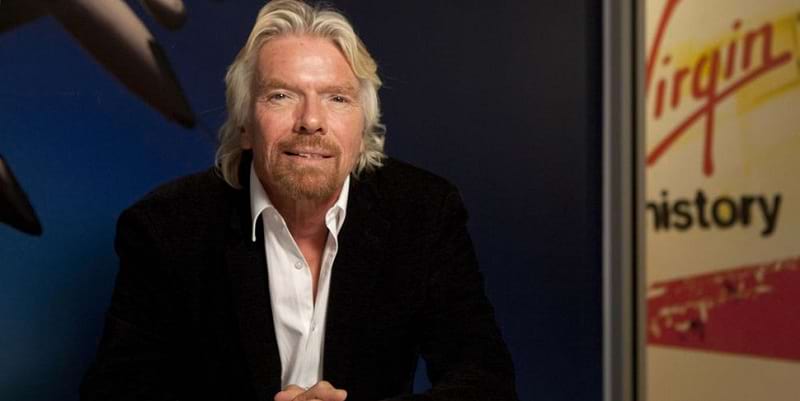
Richard Branson (Sir Richard Charles Nicholas Branson; 18 July 1950) is a business magnate, investor, adventurer, and philanthropist. He is known as the founder of Virgin Group which comprises more than 400 companies in various industries. At this moment, Richard Branson is the 6th wealthiest man in the United Kingdom and he is globally known for his record-breaking attempts in adventure activities.
Richard Branson biography
Richard Branson was born in Surrey. He grew up in a supportive family surrounded by love. They did not have a television nor listened to the radio, but according to Richard Branson, his childhood was fun. His father Ted Branson was a lawyer and his mother Eve Branson worked as an airline hostess.
Both parents highly valued Richard Branson’s independence. They encouraged him to stand on his own feet and his mother even once made him find his way back home from his grandmother’s house when he was four years old. According to Richard Branson, he got lost but he eventually made it home.

Richard Branson first went to Scaitcliffe preparatory school in Windsor Great Park. He did lots of sports with which he found popularity. Richard Branson became the captain of the football, rugby, and cricket team.
However, he suffered dyslexia which was not a known-problem by others in that time. Richard Branson was unable to continuous correctly read, write, or spell, and as a result, he was perceived as being stupid or lazy by others in his class, including his teachers.
Favorably for him that he did well in sports since his academic results were poor and this could sometimes result in being beaten by the teacher.
He went to Cliff View House school, a school to prepare for the Common Entrance exam. This school did not offer any sports and he was for the most of the time beaten. However, he met Charlotte, the headmaster’s daughter, and they had nightly visits until they got caught at one night. As a result, Richard Branson got expelled from school. He immediately pretended to commit suicide where after the inhibition became invalid.
Richard Branson went to Stowe High School in 1963. The students had many compulsory activities which in Richard Branson and Jonathan Holland-Gems experience could be improved. They believed that their ideas were revolutionary and that they need to create a new magazine in which students’ ideas can be represented. Richard Branson and Jonathan Holland-Gems created an interschool student magazine called Student.
In the preparatory phase of the new magazine, they contacted all stakeholders and Richard Branson spent little time with his family.
His family supported his incentive and helped him with writing articles and contributing to finances. He dropped out of school when he was 16 and devoted himself to the magazine. However, as Jonathan Holland-Gem decided to finish his studies, the magazine was probably going to fail.
The start of Virgin
When he experienced decreasing revenues in the company, Richard Branson tried to sell the enterprise. Unfortunately, this was not a success. Consequently, he established a mail-order record business called Virgin Mail Order in 1970. With the company’s business model, they were able to offer lower prices than competitors which eventually led to increased sales volume.
Richard Branson established Virgin Records, a chain of record stores, in the 1970s. The intention was to create a place in which people could socialize and listen to records together. The company soon became the number 1 independent record label for punk and new wave music.
In this period, in his 20s, Richard Branson got married for the first time but the marriage did not last long. He married again with Joan, and they got various children. Their first child was born premature and died after four days. They later got a daughter and son who also helped them heal from their lost baby.
Richard Branson values his family as highly important because they helped him reach his success. He stated that the love of his family keeps him driven to keep achieving things, and without that love, achieving things would not be meaningful.
He always wanted to have a suitable work and social life balance which he tries to realize for years. According to Richard Branson, he truly enjoys spending time with his family.
As the company performed well enough to expand the business, Richard Branson soon built a recording studio in Oxfordshire, various Virgin Megastores, and the Virgin Atlantic Airways in 1984.
By this time, the accumulated revenues from his approximately 50 companies were exceeding $17 million. However, Richard Branson’s success experienced a financial setback, and as a result, he sold Virgin Records for one $1 billion to raise marginal cash for Virgin Atlantic Airways.
Even though Richard Branson was forced to sell Virgin Records, his entrepreneurial ability made him innovate new business ventures. He was determined to stay in the music industry, and for this reason, he founded Virgin Radio in 1993. He also established another record company, V2 Benelux.
Virgin Atlantic Airways was also a major success. The airline company gave the extra mile and put customers first. The company was one of the first that introduced backseat video screen in every class and provided free ice creams during movies.
By the 1990s, the Virgin Group already comprised approximately 100 businesses in 35 countries.
By this time in 1993, he was awarded an honorary degree of Doctor of Technology from Loughborough University.
He was also knighted by Prince Charles in 2000 at an investiture in Buckingham Palace and was awarded the Tony Jannus Award, an award that recognizes outstanding individual achievements in scheduled commercial aviation by airline executives, inventors and manufacturers, and government leaders.
He formed Virgin Galactic, an organization that develops and operates commercial space vehicles to open space.
He also recently announced the introduction of a cruise line called Virgin Voyages and will first sail in 2020.
Richard Branson has created a branded venture capital strategy. With this strategy, he can license the Virgin name which involves minimum financial resources, and it keeps the Virgin Group continually growing.
His personality represents his success. Richard Branson is an adventurous person who dares to take risks. From the approximately 400 successful businesses that he established, another approximately 200 have failed such as Virgin Cola and Virgin Clothing.
His ability to take risks has also been demonstrated when he crossed the Atlantic- and Pacific Oceans in hot air balloons. He also Kite surfed the English Channel, and he broke a record with crossing the Atlantic in a boat.
Richard Branson’s mission, vision, and leadership style make him an extraordinary entrepreneur. His businesses are known for the continuous quality they offer such as The Virgin Group hotel in Chicago. The company ranked number 1 by Condé Nast Traveler’s 2016 Readers’ Choice Awards. To guarantee this continuous quality, he sometimes acts as a mystery shopper to improve the quality his businesses.
He received various rewards such as being one of the ‘Top 100 Most Influential People in the World’, by Times.
Richard Branson additionally received the Citizen of the World Award, an award given out by the United Nations Correspondents Association to those deemed to have made a significant contribution, for his environmental and humanitarian causes in 2007.
Richard Branson received an honorary degree of Doctor Honoris Causa from Kaunas Technology University in Kaunas and many other rewards from various parties.
At this moment, Richard Branson spends most of his time working on non-profit initiatives such as his Virgin Unite, which tries to make a positive difference in the world.
Neck Island
He is still in shape and enjoys sports such as kite-surfing, swimming, cycling, and tennis. He is the grandfather of three children and lives on Neck Island in the British Virgin Islands. He controls his businesses virtually by being available to customers online through social media and e-mail, and he maintains contact with his employees by telephone.
Net Worth
Richard Branson also possesses two islands, and Forbes estimates his net worth at approximately $5 billion.

Richard Branson quotes
- “You don’t learn to walk by following rules. You learn by doing, and by falling over.”
- “Fun is one of the most important – and underrated – ingredients in any successful venture. If you’re not having fun, then it’s probably time to call it quits and try something else.”
- “Business opportunities are like buses, there’s always another one coming.”
- “Do not be embarrassed by your failures, learn from them and start again.”
- “Being a good listener is absolutely critical to being a good leader; you have to listen to the people who are on the front line.”
- “Material things are delightful, but they’re not important.”
- “In business, if you realize you’ve made a bad decision, you change it.”
- “One thing is certain in business. You and everyone around you will make mistakes.”
- “A good leader doesn’t get stuck behind a desk.”
- “I think it’s quite great to set yourself a big challenge, and then you’ve got another reason for keeping fit.”
- “If you are a small company taking on a big company, you need to have a sense of humor.”
- “If somebody offers you an amazing opportunity but you are not sure you can do it, say yes – then learn how to do it later!”
- “Respect is how to treat everyone, not just those you want to impress.”
- “Train people well enough so they can leave, treat them well enough so they don’t want to.”
- “Throwing yourself into a job you enjoy is one of the life’s greatest pleasures!”
Books and publications
- (2007). Let’s Not Screw It, Let’s Just Do it: New Lessons for the Future. Random House Australia.
- (2007). Screw it, let’s do it: lessons in life and business. Random House.
- (2008). Business stripped bare: adventures of a global entrepreneur. Random House.
- (2008). Business stripped bare: adventures of a global entrepreneur. Random House.
- (2010). Losing my virginity: how I’ve survived, had fun, and made a fortune doing business my way. Crown Business.
How to cite this article:
Zeeman, A. (2018). Richard Branson. Retrieved [insert date] from ToolsHero: https://www.toolshero.com/toolsheroes/richard-branson/
Original publication date: 04/09/2018 | Last update: 05/11/2023
Add a link to this page on your website:
<a href=”https://www.toolshero.com/toolsheroes/richard-branson/”>ToolsHero.com: Richard Branson</a>
Alexander Zeeman
Alexander Zeeman is Content Manager at ToolsHero where he focuses on Content production, Content management and marketing. He is also an International Business student at Rotterdam Business school. Currently, in his study, working on the development of various management competencies and improving operational business processes.

Related ARTICLES
Simon Sinek biography, quotes and books
Zig Ziglar biography, motivational quotes and books
Tony Buzan biography and books