Stephen Covey biography, quotes and books
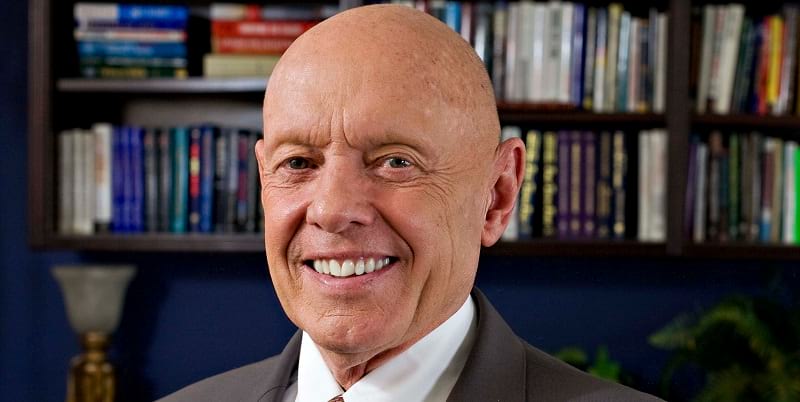
Stephen Covey (October 24, 1932 – July 16, 2012) was (co-)founder of the Franklin Covey Company (a large provider of training and consulting solutions with approximately 3,500 employees). In the last thirty years, Stephen Covey himself provided training services to various leading international organizations. He is also very well known for his research and model: The 7 Habits of Highly Effective People. This article covers his biography, quotes and books.
Who is Stephen Covey? His biography
Stephen Richards Covey was born in Salt Lake City, Utah. His parents were Stephen Glenn Covey and Irene Louise Richards Covey. Mom Louise was the daughter of Stephen L. Richards, an apostle and counselor in the first presidency of the Church of Jesus Christ of Latter-day Saints. Dad Stephen was de grandson of Stephen Mack Covey, founder of the original Little America Wyoming.
Covey held a BSc. degree in Business Administration from the University of Utah in Salt Lake City, an MBA in Business Administration from Harvard University and a doctorate (Ph.D) from Brigham Young University.

He was heavily influenced by Peter Druckers and Carl Rogers.
His religious upbringing also played a big role in his life. According to Clayton Christensen, The Seven Habits of Highly Effective People was a distillation of Latter-day Saint values.
7 Habits theory
He was a professor there before he became successful with his book The 7 Habits of Highly Effective People which helped lots of people and organizations on the topic of productivity and personal effectiveness. The book sold more than 25 million copies.
The seven habits he describes are:
- Be proactive
- Begin with the end in mind
- Put first things first
- Think win-win
- Seek first to understand, then to be understood
- Synergize
- Sharpen the saw
See also this article about the 7 Habits of Highly Effective People.
Leadership Life Success Blueprint: Covey’s 7 Habits book based course
Stephen Covey lived with his wife and their family in Provo (Utah), the town where Brigham Young University is established. A father of nine children and a grandfather of 50 grandchildren, he received the Fatherhood Award from the ‘National Fatherhood Initiative’ in 2003.
He is the founder of the Covey Leadership Center, which became ‘FranklinCovey‘ after it had been taken over by Franklinquest. The Covey Leadership Center specializes in providing training and selling products that improve productivity. He carved out a glittering career during his life.
Covey’s Highlights
- Covey sold over 25 million books (in 38 languages), including Spiritual Roots of Human Relations
- His book The Seven Habits of Highly Effective People was elected the most influential Business Book of the Twentieth Century.
- His book, The 8th Habit, From effectiveness to greatness sold almost 400,000 copies.
- International Man of Peace Award.
- Stephen Covey was recognized as one of Time magazine’s 25 most influential Americans.
- Fatherhood Award from the National Fatherhood Initiative (father of 9 children and grandfather of 50 grandchildren
- Author of the best-selling non-fiction audio book in history (The Seven Habits of Highly Effective People)
- Nr. 1 best-selling hard cover book about family life (The 7 Habits of Highly Effective Families)
- MBA from Harvard, obtained his doctorate from Brigham Young University
- Co-founder and Vice President of FranklinCovey, the leading global supplier of business services with branches in 123 countries
- International Entrepreneur of the Year Award.
- During his life he was awarded eight honorary doctorates

Famous Quotes
- “There are three constants in life… change, choice and principles.”
- “Effective leadership is putting first things first. Effective management is discipline, carrying it out.”
- “The main thing is to keep the main thing the main thing.”
- “The key is not to prioritize what’s on your schedule, but to schedule your priorities.”
- “Live out of your imagination, not your history.”
- “Management is efficiency in climbing the ladder of success; leadership determines whether the ladder is leaning against the right wall.”
- “The key is taking responsibility and initiative, deciding what your life is about and prioritizing your life around the most important things.”
- “Life is not accumulation, it is about contribution.”
- “Employers and business leaders need people who can think for themselves – who can take initiative and be the solution to problems.”
- “The challenge of work-life balance is without question one of the most significant struggles faced by modern man.”
- “But until a person can say deeply and honestly, “I am what I am today because of the choices I made yesterday,” that person cannot say, “I choose otherwise.”
- “Most people do not listen with the intent to understand; they listen with the intent to reply.”
- “Treat a man as he is and he will remain as he is. Treat a man as he can and should be and he will become as he can and should be.”
Books and Publications by Stephen Covey et al.
- 2016. Primary Greatness: The 12 Levers of Success. Simon and Schuster.
- 2014, 1998. The 7 habits of highly effective families. St. Martin’s Press.
- 2014, 2008. The Leader in Me: How Schools and Parents Around the World Are Inspiring Greatness, One Child At a Time. Simon and Schuster.
- 2014. The Leader in Me: How Schools Around the World Are Inspiring Greatness, One Child at a Time. Simon and Schuster.
- 2013, 2004. The 8th habit: From effectiveness to greatness. Simon and Schuster.
- 2012. The 3rd Alternative: Solving Life’s Most Difficult Problems. Simon and Schuster.
- 2009. The 7 Habits of Highly Effective Network Marketing Professionals. ISBN 978-1-933057-78-1.
- 2006. The speed of trust: The one thing that changes everything. Simon and Schuster.
- 2006. Servant-leadership and community leadership in the 21st century. The International Journal of Servant-Leadership, 2(1), 103-109.
- 2006. Servant leadership. Leadership Excellence, 23(12), 5-6.
- 2006. The ultimate question: Driving good profits and true growth. Harvard Business School Press.
- 2006. Leading in the knowledge worker age. The leader of the future, 2, 215-226.
- 2004. 6 Events: The Restoration Model for Solving Life’s Problems. ISBN 1-57345-187-8.
- 2004. The Seven Habits of Highly Effective People. Free Press.
- 2000. Living the Seven Habits. ISBN 0-684-85716-2.
- 1999. Living the 7 habits: stories of courage and inspiration. Simon and Schuster.
- 1998. Servant-leadership from the inside out. Insights on leadership: Service, stewardship, spirit, and servant leadership.
- 1998. The ideal community. In Community of the Future (pp. 49-58).
- 1997. The habits of effective organizations. Leader to leader, 1997(3), 22-28.
- 1996. Three roles of the leader in the new paradigm. The leader of the future, 149-160.
- 1995. First things first. Simon and Schuster.
- 1994. First things first. EXECUTIVE EXCELLENCE, 11, 3-3.
- 1992. The seven habits of highly effective people. Journal of Et Nursing, 19(3), 103.
- 1991. The taproot of trust. Executive Excellence, 8(12), 3-4.
- 1990. Principle Centered Leadership. Simon and Schuster.
- 1989. The seven habits of highly effective leaders. Simon & Schuster, New York. Coviello, Decio, Nicola Persico, and Andrea Ichino,(2014). Time Allocation and Task juggling. The American Economic Review, 104(2), 609-23.
- 1982. The Divine Center. Bookcraft Pubs.
- 1973. Spiritual roots of human relations. Deseret Book Co.
- 1971. How to succeed with people. Shadow Mountain.
- 1970. Spiritual Roots of Human Relations. ISBN 0-87579-705-9.
How to cite this article:
Van Vliet, V. (2009). Stephen Covey. Retrieved [insert date] from Toolshero: https://www.toolshero.com/toolsheroes/stephen-covey/
Original publication date: 12/16/2013 | Last update: 01/05/2024
Add a link to this page on your website:
<a href=”https://www.toolshero.com/toolsheroes/stephen-covey/”>Toolshero: Stephen Covey</a>

Vincent van Vliet
Vincent van Vliet is co-founder and responsible for the content and release management. Together with the team Vincent sets the strategy and manages the content planning, go-to-market, customer experience and corporate development aspects of the company.

Related ARTICLES

Business Model You by Timothy Clark: a Summary

Brian Tracy biography, quotes and books

Outline Method of Note Taking


SQ3R Method explained plus example