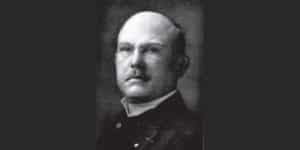
William Edwards Deming biography and books
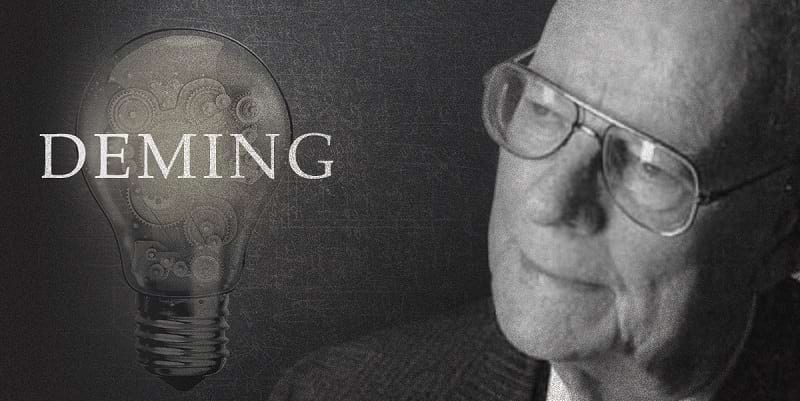
William Edward Deming (1900-1993) was an American statistician. William Edwards Deming was a famous quality management guru who strived for continuous improvement of organizations. The origin of his work can be found in the Japanese manufacturing industry. There he learned about the management principles of statistical process control (SPC), a precursor of Total Quality Management (TQM). This is also why he was considered to be the most influential non-Japanese person in the field of the Japanese manufacturing industry. He was also the proponent of the famous Plan-Do-Check-Act model and his 14 points on Management. This article highlights his biography and career, quotes, his books and other publications. Enjoy reading!
Dr. William Edward Deming biography
William Edwards Deming obtained a Bachelor’s degree (BSc.) in electrical engineering from the University of Wyoming.
In 1925, he obtained his Master’s degree (MSc.) in statistics from the University of Colorado. And last but not least, William Edwards Deming obtained his doctorate (Ph.D.) in statistics and statistical physics from Yale University in 1928.

He studied for some years with dr. Walter Andrew Shewhart of Bell Telephone Laboratories. Shewhart’s theories about statistical control methods formed the basis for Deming’s work.
In 1940, William Edwards Deming developed several sampling techniques. He taught Statistical Process Control (SPC) techniques to the labourers who were engaged in wartime production. These techniques were widely applied during the World War Two.
After World War Two, he was involved in issues concerning the Japanese economy. His expertise, combined with his involvement in Japanese society, led to an invitation from the Japanese Union of Scientists and Engineers (JUSE) to participate in projects.
JUSE members had studied Shewhart’s techniques i.e. Quality Control. As part of Japan’s reconstruction, they sought an expert to teach Statistical Process Control (SPC) and his 14 points on Management.
In 1950, William Edwards Deming taught his first of a dozen courses about Statistical Quality Control (SQC). This time he conducted the session for Japanese top management.
Its purpose was to convey the message: “improvement of quality will lead to a reduction of expenses and to an increase of productivity and market share”. Several (large) Japanese manufacturers applied Deming’s techniques and were therefore able to create a new international demand for Japanese products.
In 1960 William Edwards Deming was the first American to be awarded with the Second Order of the Sacred Treasures (a Japanese award) from the then Prime Minister Nobusuke Kishi.
He received this award because the Japanese people recognized his contributions to the rebirth of their industry. Thereafter he continued his work at an international level and he received many nominations and awards.
In December 1993, William Edwards Deming died in his sleep at the age of 93 in his Washington home at about 3 a.m. due to “natural causes”.
William Edwards Deming quotes
- “Profit in business comes from repeat customers, customers that boast about your project or service, and that bring friends with them.”
- “It is not enough to do your best; you must know what to do, and then do your best.”
- “It is not necessary to change. Survival is not mandatory.”
- “If you can’t describe what you are doing as a process, you don’t know what you’re doing.”
- “Quality is everyone’s responsibility.”
- “Innovation comes from the producer – not from the customer.”
- “If you do not know how to ask the right question, you discover nothing.”
- “You should not ask questions without knowledge.”
- “Learning is not compulsory… neither is survival.”
- “The result of long-term relationships is better and better quality, and lower and lower costs.”
- “Rational behaviour requires theory. Reactive behaviour requires only reflex action.”
- “We are here to make another world.”
- “Lack of knowledge… that is the problem.”
- “All anyone asks for is a chance to work with pride.”
- “Whenever there is fear, you will get wrong figures.”
Books and Publications
- 2000, 1993. The New Economics. MIT Press.
- 2000, 1986. Out of the Crisis. MIT Press.
- 2000. On errors in surveys. Bobbs-Merrill Company.
- 1992. Profound knowledge. British Deming Association.
- 1990. Sample Designs in Business Research. John Wiley and Sons Inc.
- 1986. Statistical method from the viewpoint of quality control. Courier Corporation.
- 1985, 1964, 1943. Statistical Adjustment of Data. John Wiley and Sons.
- 1985, 1966. Some theory of sampling. Dover Publications Inc.
- 1982. Quality, productivity, and competitive position. Massachusetts Institute of Technology, Center for Advanced Engineering Study.
- 1981. On the management of statistical techniques for quality and productivity. W. Edwards Deming.
- 1969. A further account of the idiots savants, experts with the calendar. American Journal of Psychiatry, 126(3), 412-415.
- 1967. What happened in Japan?. Society of Quality Control Engineers.
- 1963. Facsimiles of two papers by Bayes. Hafner Publishing Company.
- 1960. Sample Design in Business Research. John Wiley and Sons.
- 1950 / 1966. Some Theory of Sampling. Dover Publications.
- 1950 / 1952. Elementary Principles of the Statistical Control of Quality. Nippon Kagaku Gijutsu Renmei, Tokyo.
- 1948. A brief statement on the uses of sampling in censuses of population, agriculture, public health, and commerce. United Nations.
- 1943. Statistical adjustment of data.
- 1943. On the efficiency of deep stratification in block sampling. Journal of the American Statistical Association, 38(221), 93-100.
- 1939. Statistical method from the viewpoint of quality control. Courier Corporation.
- 1938. Least Squares. The Graduate School, Department of Agriculture, Washington.
How to cite this article:
Van Vliet, V. (2009). William Edward Deming. Retrieved [insert date] from Toolshero: https://www.toolshero.com/toolsheroes/william-edwards-deming/
Original publication date: 11/11/2009 | Last update: 12/28/2023
Add a link to this page on your website:
<a href=”https://www.toolshero.com/toolsheroes/william-edwards-deming/”> Toolshero: William Edward Deming</a>

Vincent van Vliet
Vincent van Vliet is co-founder and responsible for the content and release management. Together with the team Vincent sets the strategy and manages the content planning, go-to-market, customer experience and corporate development aspects of the company.

Related ARTICLES
Charles Kepner biography and books

Eight Dimensions of Quality by David Garvin

Agile Crystal Method explained

Philip Crosby biography, quotes and books