14 Principles of Management by Henri Fayol

14 Principles of Management: this article explains the administrative theory and management theory of 14 Principles of Management, developed by Henri Fayol in a practical way. Every principle is being explained with practical examples, next to the history. After reading you will understand the basics of this scientific management theory. Enjoy reading!
History and the develoment of the 14 principles of management
In the last century, organizations already had to deal with management in practice. In the early 1900s, large organizations, such as production factories, had to be managed too. At the time there were only few (external) management tools, models, theory and methods available.
Thanks to scientists like Henri Fayol (1841-1925) the first foundations were laid for modern scientific management. These first concepts, also called principles of management are the underlying factors for successful management.

Henri Fayol explored this comprehensively and, as a result, he synthesized the 14 principles of management. Henri Fayol’s principles of management and research were published in the book ‘General and Industrial Management’ (1916).
Henri Fayol’s 14 Principles of Management explained including examples
Henri Fayol’s 14 Principles of Management are statements that are based on a fundamental truth. These principles of management serve as a guideline for decision-making and management actions.
They are drawn up by means of observations and analyses of events that managers encounter in practice. Henri Fayol was able to synthesize 14 principles of management after years of study.
These principles of management are:
- Division of Work
- Authority and Responsibility
- Discipline
- Unity of Command
- Unity of Direction
- Subordination of Individual Interest
- Remuneration
- The Degree of Centralization
- Scalar Chain
- Order
- Equity
- Stability of Tenure of Personnel
- Initiative
- Esprit de Corps
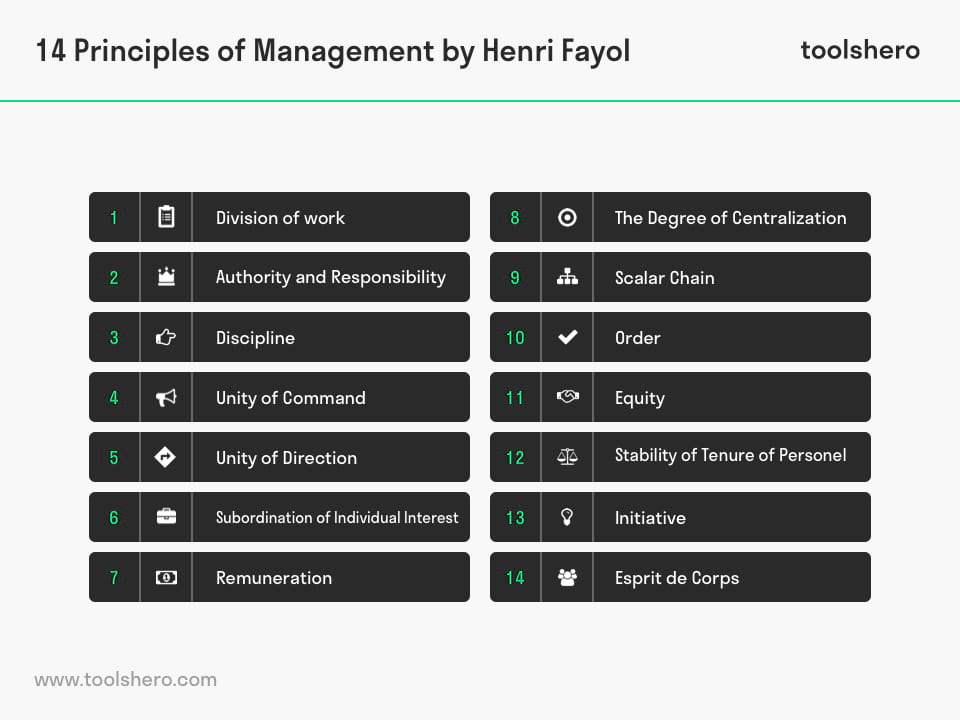
Figure 1 – Henri Fayol’s 14 Principles of Management (Fayol, 1916)
1. Division of Work
In practice, employees are specialized in different areas and they have different skills. Different levels of expertise can be distinguished within the knowledge areas (from generalist to specialist).
Personal and professional developments support this. According to Henri Fayol specialization promotes efficiency of the workforce and increases productivity. In addition, the specialization of the workforce increases their accuracy and speed. This management principle of the 14 principles of management is applicable to both technical and managerial activities.
2. Authority and Responsibility
In order to get things done in an organization, management has the authority to give orders to the employees. Of course with this authority comes responsibility. According to Henri Fayol, the accompanying power or authority gives the management the right to give orders to the subordinates.
The responsibility can be traced back from performance and it is therefore necessary to make agreements about this. In other words, authority and responsibility go together and they are two sides of the same coin.
3. Discipline
This third principle of the 14 principles of management is about obedience. It is often a part of the core values of a mission statement and vision in the form of good conduct and respectful interactions. This management principle is essential and is seen as the oil to make the engine of an organization run smoothly.
4. Unity of Command
The management principle ‘Unity of command’ means that an individual employee should receive orders from one manager and that the employee is answerable to that manager.
If tasks and related responsibilities are given to the employee by more than one manager, this may lead to confusion which may lead to possible conflicts for employees. By using this principle, the responsibility for mistakes can be established more easily.
5. Unity of Direction
This management principle of the 14 principles of management is all about focus and unity. All employees deliver the same activities that can be linked to the same objectives. All activities must be carried out by one group that forms a team. These activities must be described in a plan of action.
The manager is ultimately responsible for this plan and he monitors the progress of the defined and planned activities. Focus areas are the efforts made by the employees and coordination.
6. Subordination of Individual Interest
There are always all kinds of interests in an organization. In order to have an organization function well, Henri Fayol indicated that personal interests are subordinate to the interests of the organization (ethics).
The primary focus is on the organizational objectives and not on those of the individual. This applies to all levels of the entire organization, including the managers.
Management Skills Training for New & Experienced Managers
7. Remuneration
Motivation and productivity are close to one another as far as the smooth running of an organization is concerned. This management principle of the 14 principles of management argues that the remuneration should be sufficient to keep employees motivated and productive.
There are two types of remuneration namely non-monetary (a compliment, more responsibilities, credits) and monetary (compensation, bonus or other financial compensation). Ultimately, it is about rewarding the efforts that have been made.
8. The Degree of Centralization
Management and authority for decision-making process must be properly balanced in an organization. This depends on the volume and size of an organization including its hierarchy.
Centralization implies the concentration of decision making authority at the top management (executive board). Sharing of authorities for the decision-making process with lower levels (middle and lower management), is referred to as decentralization by Henri Fayol. Henri Fayol indicated that an organization should strive for a good balance in this.
9. Scalar Chain
Hierarchy presents itself in any given organization. This varies from senior management (executive board) to the lowest levels in the organization. Henri Fayol’s “hierarchy” management principle states that there should be a clear line in the area of authority (from top to bottom and all managers at all levels).
This can be seen as a type of management structure. Each employee can contact a manager or a superior in an emergency situation without challenging the hierarchy. Especially, when it concerns reports about calamities to the immediate managers/superiors.
10. Order
According to this principle of the 14 principles of management, employees in an organization must have the right resources at their disposal so that they can function properly in an organization. In addition to social order (responsibility of the managers) the work environment must be safe, clean and tidy.
11. Equity
The management principle of equity often occurs in the core values of an organization. According to Henri Fayol, employees must be treated kindly and equally.
Employees must be in the right place in the organization to do things right. Managers should supervise and monitor this process and they should treat employees fairly and impartially.
12. Stability of Tenure of Personnel
This management principle of the 14 principles of management represents deployment and managing of personnel and this should be in balance with the service that is provided from the organization.
Management strives to minimize employee turnover and to have the right staff in the right place. Focus areas such as frequent change of position and sufficient development must be managed well.
13. Initiative
Henri Fayol argued that with this management principle employees should be allowed to express new ideas. This encourages interest and involvement and creates added value for the company.
Employee initiatives are a source of strength for the organization according to Henri Fayol. This encourages the employees to be involved and interested.
14. Esprit de Corps
The management principle ‘esprit de corps’ of the 14 principles of management stands for striving for the involvement and unity of the employees. Managers are responsible for the development of morale in the workplace; individually and in the area of communication.
Esprit de corps contributes to the development of the culture and creates an atmosphere of mutual trust and understanding.
In conclusion on the 14 Principles of Management
The 14 principles of management can be used to manage organizations and are useful tools for forecasting, planning, process management, organization management, multiple Project Management Methodologies, decision-making, coordination and control.
Although they are obvious, many of these matters are still used based on common sense in current management practices in organizations. It remains a practical list with focus areas that are based on Henri Fayol ’s research which still applies today due to a number of logical principles.

It’s Your Turn
What do you think? What are the Henry Fayol’s 14 principles of management of today’s management? Do these management principles work in every organization or are there exceptions? And if so, what are the exceptions and what can we learn from them?
Share your experience and knowledge in the comments box below.
More information
- Fayol, H. (1917). General and Industrial Management. Dunod et E. Pinat.
- Hodge, B. J. (2002). Organization theory: a strategic approach. Pearson Education.
- Wren, D. A. , Bedeian, A. G. , Breeze, J. D. (2002). The foundations of Henri Fayol’s administrative theory. Management Decision, Vol. 40 Iss: 9, pp.906 – 918 state: It was not until the Storr’s translation that Fayol’s (1949) Administration Industrielle et Générale reached a wider audience, especially in the USA and established Fayol as a major authority on management.
How to cite this article:
Van Vliet, V. (2009). 14 Principles of Management (Fayol). Retrieved [insert date] from Toolshero: https://www.toolshero.com/management/14-principles-of-management/
Original publication date: 09/07/2009 | Last update: 04/08/2024
Add a link to this page on your website:
<a href=”https://www.toolshero.com/management/14-principles-of-management/”>Toolshero: 14 Principles of Management (Fayol)</a>

Vincent van Vliet
Vincent van Vliet is co-founder and responsible for the content and release management. Together with the team Vincent sets the strategy and manages the content planning, go-to-market, customer experience and corporate development aspects of the company.

Related ARTICLES

Amy Edmondson biography and books

Scientific Management Theory and Taylorism

Bureaucratic Theory of Management by Max Weber

Daniel Ofman biography and books