Tuckman’s Stages of Group Development explained
A team rarely starts out as a well-oiled machine. In the beginning, there is often uncertainty about goals, roles, and expectations. This is followed by discussions, irritations, and minor conflicts. That’s not unusual. It’s team development. Bruce Tuckman’s Stages of Group Development helps you understand and guide that development. It shows how teams grow through fixed phases, from forming to storming, norming, and performing, with adjourning as a possible conclusion. For managers, the model provides guidance on choosing the right approach for each phase. More structure at the beginning, better guidance when tensions arise, and later on, above all, giving room for ownership. For employees, it makes it clear why collaboration can sometimes be difficult and what is needed to take the team to the next level.

In this article, you will discover what the Tuckman’s Stages of Group Development is, how it originated, and what the five stages mean in practice. You will read about the signs that characterize each stage and the actions that help to improve collaboration. You will also see how to use the model in a team session so that you can link language and agreements to it together. Finally, we will consider limitations and criticism, so that you can use the model realistically as a tool, not as a label. Enjoy reading!
What are the Tuckman’s Stages of Group Development? The explanation
When people work together within an organization, it often takes some time before they function as a team. To gain more insight into this team development, Bruce Tuckman developed a four-phase model.
In 1977, he added a fifth stage, and the group dynamics model became known as the Tuckman model.
It’s all about cooperation
Bruce Tuckman is convinced that a team must go through different stages in order to ultimately work together effectively and function well, which leads to higher quality.
This increases group dynamics. Only after a team has gone through the various stages within the Tuckman’s Stages of Group Development (forming, storming, norming, etc.) and is performing well together can they say goodbye to each other from the fifth stage and potentially collaborate with other teams.
Why the Tuckman model is important for modern teams
The Tuckman’s Stages of Group Development model helps to better understand behavior and tensions in teams. Instead of viewing every conflict or misunderstanding as a problem, the model shows that team development goes through different phases. Forming, storming, norming, and performing are not mistakes in the process, but logical steps on the way to collaboration that really works.
This is relevant for modern organizations because they increasingly work in project teams, agile teams, and temporary working groups. People from different disciplines come together quickly, have to perform under time pressure, and have little time to get to know each other. As a result, the storming moments are often clearly visible. The Tuckman model then offers a language to interpret this and make it normal.
For managers, the model provides guidance in their role. They are more likely to see when a team is stuck in a certain phase and can adjust their approach accordingly. In the initial phase of the Tuckman’s Stages of Group Development, structure and clarity are particularly important. In the storming phase, it is more a matter of guiding conflicts and helping to make agreements. In later phases, the emphasis is more on giving space and working in a results-oriented manner.
For team members, the model is recognizable and relieving. It helps to see that friction, uncertainty, or ambiguity does not automatically mean that the team is failing, but that this is part of growth. This makes it easier to discuss with each other what is needed to take a step further together towards a better functioning team.
Sequence of the Tuckman model
The five Stages within the Tuckman’s Stages of Group Development model provide insight into the development of a team over time. According to Tuckman, the stages must be completed in a fixed order. Only then can a team function optimally.
As long as a team has not gone through joint conflicts and has not established behavioral norms, it will never perform well.
Team norms and collaboration
Team members who work together understand the basic principles which enable them to work collaboratively. The event did not occur as a natural consequence. The team needed to learn about their individual work methods before they could begin their collaborative work. The team members developed their understanding of proper conduct through their work experiences while they understood which performance standards needed to be met and they discovered methods to support their teammates. These are team norms.
Team norms operate as guidelines which direct the collaborative efforts of team members. People follow rules which exist as norms but these rules do not exist in any written form. The team members understand these unwritten rules through their unspoken agreement.
Group members develop norms through their social interactions with each other. The first set of norms establishes rules which determine the amount of work required plus the expected level of success. The norms which follow establish standards for both workplace relationships and work performance standards. The establishment of performance norms serves to define the necessary work effort and the desired level of achievement. Leaders play an important role in this process.
Norms achieve their purpose of behavior control when the group makes a decision to accept them. A team’s level of cohesion depends directly on whether team members choose to follow or ignore the established rules.
Tuckman model: the five stages of group development
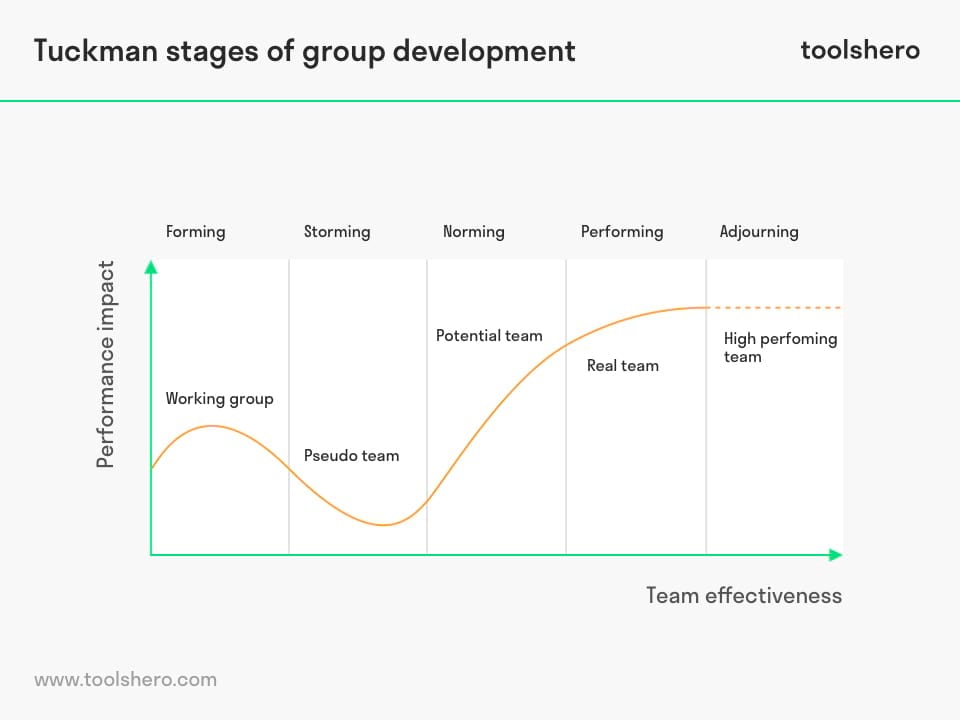
Bruce Tuckman distinguishes five stages in group development and team building within the Tuckman’s Stages of Group Development model. These stages do not always have to be followed strictly in sequence; teams often get stuck halfway through.
Rules of conduct and agreements are then drawn up, which are not always productive. The first two stages involve social-emotional tasks. Stages three and four focus more on task-oriented tasks.

Figure 1 – Bruce Tuckman ‘s Stages of Group Development
Forming
In the forming phase of Tuckman’s Stages of Group Development model, a new team has just been formed. The team members are primarily focused on orientation. Who is on the team, what are the tasks, and how are we going to work together? Roles and responsibilities have not yet been clearly defined, and team performance is low. Many team members do not yet know exactly what the team’s SMART goals are and what is expected of them. This often makes this phase unclear and uncertain.
The manager notices that team members are hesitant, ask a lot of questions, and mainly look to him or her for direction. There is a need for structure, clear agreements, and clearly formulated expectations. The manager’s most important task here is to provide a framework, explain the goal, and radiate confidence in the team.
The employee experiences everything as new. They are searching for their place, role, and tasks. It does not yet feel natural to be completely open or to express differing opinions. The initial focus is on connecting with the team and understanding what is needed to function well.
Storming
The storming phase of Tuckman’s Stages of Group Development model establishes trust between members while their different perspectives become more noticeable. Team members express themselves more freely and reveal their own styles and preferences. The situation has developed into a conflict between the two groups. The group members discuss their work duties and establish their most important tasks and their power levels and their preferred work approaches. Group members seek their position in the group. The group continues to resist because members want to stay part of the community.
The manager observes that the environment undergoes alterations in its emotional state. The team members hold different perspectives which create conflicts and they discuss matters through informal discussions. The person should guide the discussion toward its intended direction instead of attempting to resolve all problems immediately. The process requires organizations to create areas where different perspectives can emerge while they assist teams in recognizing their challenges and direct them toward establishing defined agreements.
The employee notices that the tension is increasing. The pace of work along with its quality and style elements have started to display significant differences. People require both recognition and influence to satisfy their needs. Team members should learn to provide feedback about behaviors instead of personal attacks while they work on recognizing their individual needs and developing team-based agreements which benefit all members.
Norming
During the norming stage of Tuckman’s Group Development model members develop their ability to work together effectively. The storm remains active yet the group has developed improved skills to handle its challenges. Work-based criticism serves as a constructive development tool which people tend to view instead of viewing it as an attack on their personality. Team members now show greater acceptance of each other’s concepts while they work to establish common ground. The organization creates common rules together with shared standards and working methods. The team members have documented their common objectives which all members can access.
The team members show increasing responsibility according to what the manager has observed. The need for detailed guidance decreases. The person shifts their work approach to provide team members with coaching and facilitation and support instead of focusing on correction and explanation. The manager tracks the direction of work yet enables workers to make independent decisions during task performance.
The employee experiences more clarity and security. People have a better understanding of what they can expect from each other and how the collaboration is organized. Positive experiences strengthen trust. Team members feel part of a whole and are more willing to help each other and hold each other accountable for agreements.
Performing
The team operates as a unified group during the performing stage of Tuckman’s Stages of Group Development model. Most of the energy is focused on the content and achieving results. Members of the team perform their tasks separately while they coordinate their work and support each other’s efforts. The team members fully support the set goals because these goals have been established with complete team agreement. The team tracks its progress while making necessary adjustments to its approach. The workplace environment allows employees to take initiative while they seek ways to enhance their work.
The manager notices that the team has little need for daily guidance. The role shifts to removing obstacles, arranging preconditions, and monitoring the course and priorities. The manager can devote more attention to strategy, collaboration with other teams, and leveraging the team’s strengths.
The worker observes that all operations proceed without any problems. Each person understands their assigned duties and everyone recognizes the responsibilities assigned to others. People have enough freedom to choose their path while they participate in common decision-making processes and problem-solving activities. People handle conflicts at a faster rate while showing better maturity in their actions.
Adjourning
In the adjourning phase of Tuckman’s Stages of Group Development model, the team’s assignment has been completed and the team is disbanded or continues in a modified form. Team members may have mixed feelings. They may be proud of the results achieved, but at the same time feel sad or uncomfortable about the loss of the familiar group. People often distance themselves somewhat before the team formally ends, to make the end feel less abrupt.
The manager notices that the focus is shifting from performance to completion. There is a need for recognition of what the team has achieved and clarity about what comes next. It is important to take time for evaluation, handover, and a fitting farewell. A joint review, identifying learning points, and marking the end help in this regard.
The employee experiences routines falling away and the team spirit changing. Some look forward to a new assignment, others find it difficult to let go. A clear conclusion and attention to everyone’s contribution make it easier to close this phase and move on to the next role or a new team with more peace of mind.
Applying the Tuckman model in a team session
The Tuckman’s Stages of Group Development model is most valuable when discussed with the team. A short, focused session helps to discuss behavior and cooperation and to make agreements together for the next step in team development.
Step 1. Explain the model in plain language
Start with a brief explanation of the phases: forming, storming, norming, performing, and possibly adjourning. Do this in your own words and with recognizable examples from work. The goal is not to teach theory, but to create a common language for what the team is experiencing.
Step 2. Have each team member determine the current phase
Ask each team member to think individually about which phase they believe the team is currently in. Have them write this down briefly, with one or two concrete signs that go with it. Think of comments such as “there is a lot of uncertainty about roles,” “we regularly have tensions about priorities,” or “we solve problems quickly together.”
Step 3. Share and compare the images
Have team members share one by one which phase they choose and why. Write down the phases and examples mentioned so that everyone can see them. This often leads to a discussion about differences in perception. The role of the manager here is mainly to organize and summarize, not to defend or correct.
Step 4. Identify patterns in behavior and collaboration
Look for recurring patterns together. If many examples of unclear goals emerge, this is part of forming. A lot of tension about working methods and the division of roles indicates storming. More agreements about standards and collaboration are typical of norming. Results-oriented work with little fuss indicates performing. Always briefly explain the link between behavior and the phase.
Step 5. Formulate what is needed to take a step forward
Then ask what this team needs to grow to the next phase. In a forming team, this may be more clarity about goals and roles. In a storming team, it may be more time to discuss tensions and make working agreements. In a norming team, it may be more room for initiative and responsibility. Let the team make their own suggestions.
Step 6. Make two or three concrete agreements
Conclude the session with a maximum of two or three concrete agreements for the coming weeks. Consider a fixed place for feedback in the weekly meeting, the explicit distribution of roles in projects, or the joint refinement of team goals. Record who does what and when this will be revisited.
Step 7. Plan a brief review
After four to six weeks, schedule a brief moment to evaluate. Ask again what phase the team sees itself in now, which agreements have helped, and what the next step could be. This way, the Tuckman model becomes not a one-time exercise, but an ongoing tool for consciously shaping team development.
Limitations and criticism of the Tuckman’s Stages of Group Development model
Tuckman’s Stages of Group Development model is a useful framework for describing team development, but it also has clear limitations. In practice, team development does not always proceed in neat, sequential stages. Teams can skip steps, revert to an earlier stage, or exhibit characteristics of different stages simultaneously. The model therefore provides a simplified picture of a much more complex process.
A second limitation is that the model is mainly based on research into relatively small groups in specific contexts. Large departments, multidisciplinary project organizations, or international teams often have more layers, subgroups, and dependencies. The behavior and dynamics at play there cannot always be captured well in four or five stages.
There is also criticism of the tendency to label teams too quickly. Once a team is labeled as a storming team, there is a risk that every conflict will be seen as “typical for this phase” and that underlying causes will no longer be investigated. Examples include unclear management, structural work pressure, or unclear goals. The model should not narrow the focus to only the inside of the team.
In addition, Tuckman’s Stages of Group Development model mainly describes internal group dynamics. External factors such as organizational culture, leadership style in the rest of the organization, systems, compensation, and structure remain largely out of the picture. Yet these factors often have a major impact on how a team develops and performs.
For these reasons, it is wise to use Tuckman’s Stages of Group Development model as a tool and language to talk about teams, not as a hard diagnosis or standard. It can help to recognize behavior, structure conversations, and manage expectations. For a complete picture, it is necessary to combine it with other perspectives, such as organizational science, leadership, and concrete analyses of goals, roles, and processes.
Frequently asked questions about Tuckman’s stages of group development
What are Tuckman’s stages of group development?
Tuckman’s Stages of Group Development describe the natural evolution of a team as it moves from initial orientation to high-level performance. (Tuckman, 1965) → This book explains that tension and adjustments are not signs of failure but necessary steps toward collective maturity.
What are the five stages of group development?
The model identifies five distinct phases that teams navigate during their lifecycle:
- Forming, orientation and testing
- Storming, conflict and resistance
- Norming, cohesion and standards
- Performing, synergy and results
- Adjourning, termination and reflection
(Tuckman & Jensen, 1977) → This book added the final stage to address the psychological process of a team disbanding after a project.
How do you use Tuckman’s stages in practice?
Effective use of the model involves identifying a team’s current phase so leadership style and support can be adjusted accordingly. The Toolshero article suggests a team-session approach where members compare perceptions of their current stage. This shared language helps prevent storming from being seen as a personal conflict and reframes it as a structural part of team development.
When does the model work less well?
The model is less effective if applied as a rigid, linear sequence. (Bonebright, 2010) → This book or study notes that teams frequently regress to earlier stages due to changes in leadership, goals, or external pressure. Treating the model as a fluid guide rather than a fixed label leads to better results.
Recommended books and articles about Tuckman’s Stages of Group Development
Tuckman’s Stages of Group Development helps explain group development step by step, from initial orientation to high-level collaboration and closure. These books provide a solid foundation for the logic behind forming, storming, norming, performing, and adjourning, while the articles show how the Tuckman’s Stages of Group Development originated, was tested, and was later further developed. This gives you a clear framework for better recognizing team dynamics and providing more targeted guidance.
- Al-Sabbagh, K., & Gren, L. (2019). The connections between group maturity, software development velocity and planning effectiveness. arXiv. → Links group development to performance in software teams, demonstrating the practical value of the performance management model.
- Bonebright, D. A. (2010). 40 years of “Storming”: A historical review of Tuckman’s model of small-group development. Human Resource Development International, 13(1), 111-120. → Historical overview showing how the model has developed and been critically evaluated.
- Egolf, D. B. (n.d.). Forming Storming Norming Performing: Successful Communication in Groups and Teams (3rd ed.). → Practical book that links the phases to communication styles and group dynamics in teams.
- Graffius, S. M. (2023). Use the phases of team development (based on Bruce W. Tuckman’s model of forming, storming, norming, performing, and adjourning) to help teams grow and advance: 2023 update. [Manuscript]. → Recent update of the model in a team and agile context, suitable for modern application.
- Gren, L., Torkar, R., & Feldt, R. (2019). Group development and group maturity when building agile teams: A qualitative and quantitative investigation at eight large companies. arXiv. → Investigates how team development (maturity) relates to Tuckman’s stages in an agile context — relevant for modern working methods.
- Maples, M. F. (1988). Group development: Extending Tuckman’s theory. Journal for Specialists in Group Work, 13(1), 17-23.
- Tuckman, B. W. (1965). Developmental sequence in small groups. Psychological Bulletin, 63(6), 384-399. → The original article in which Tuckman introduced the model — essential for understanding the core of the model.
- Tuckman, B. W., Abry, D. A., Adams, M. P., & Smith, D. R. (2007). Learning and motivation strategies: Your guide to success. Prentice Hall.
How to cite this article:
Mulder, P. (2013). Tuckman’s Stages of Group Development. Retrieved [insert date] from Toolshero: https://www.toolshero.com/management/tuckman-stages-of-group-development/
Original publication date: July 6, 2013 | Last update: March 22, 2026
Add a link to this page on your website:
<a href=”https://www.toolshero.com/management/tuckman-stages-of-group-development/”>Toolshero: Tuckman’s Stages of Group Development</a>