
Hoshin Kanri explained: the Basics, the 7 Steps, an Example, and Template
Hoshin Kanri helps you not only formulate strategy but also effectively translate it into clear goals, priorities, and actions. Many organizations have a strategic plan but struggle with its implementation. Goals remain too abstract, responsibilities are not clearly defined, and day-to-day activities do not sufficiently align with the long-term direction.
The Hoshin Kanri method helps you bring focus to the process. It helps translate breakthrough objectives into annual goals, measurable results, improvement priorities, and concrete action plans. The X-matrix visually illustrates these connections, making it clear which activities contribute to which goals and who is responsible for what.
In this article, you’ll discover what Hoshin Kanri is, the difference between Hoshin Kanri and the X-matrix, and how to apply the method step by step. You’ll also learn how Hoshin Kanri relates to the PDCA cycle, what “Catchball” means, and how the Obeya Room Method can help centralize visibility of strategy, progress, and actions. In addition, you can download a Hoshin Kanri Matrix template to get started right away. Enjoy reading.
What is Hoshin Kanri?
Many companies struggle with translating strategic plans into actionable items on a daily process.
Hoshin Kanri Matrix is a tool that can be helpful in:

- Creating SMART Goals: targets to improve and long term goals
- Determining Strategies
- Establishing Metrics
- Creating Action Plans
- Reviewing Progress on the strategy execution
It has been known by several names: policy deployment, X-matrix. Hoshin Kanri has its roots in the Toyota Production System and is a very powerful tool.
Based on a concept popularized in Japan in the late 1950s by Professor Yoji Akao. “Each person is the expert in his or her job, and Japanese TQC [Total Quality Control] is designed to use the collective thinking power of all employees to make their organization the best in its field.”
What is the difference between Hoshin Kanri and the X-matrix?
Hoshin Kanri and the X-matrix are often used together, but they are not the same. Hoshin Kanri is a method by which an organization translates its strategy into concrete goals, priorities, and actions. It helps connect an organization’s long-term direction with what needs to be done on a daily basis to achieve these goals.
The X-matrix is a tool that can be used within Hoshin Kanri. The matrix brings together various components of the strategy into a single visual overview. These include long-term goals, annual objectives, improvement priorities, measurable results, and the people responsible for implementation.
The difference, therefore, lies primarily in their function. Hoshin Kanri describes the way in which strategy is defined, aligned, implemented, and monitored. The X-matrix makes these connections visible. This clarifies which activities contribute to which goals and who is responsible for them.
An organization can apply Hoshin Kanri without using an X-matrix. Conversely, simply filling out an X-matrix does not guarantee that Hoshin Kanri is actually being applied. It is precisely the combination of clear goals, alignment, implementation, and regular evaluation that makes the method valuable.
What is the Hoshin Kanri Matrix?
Properly used, Hoshin Kanri Matrix will help employees to focus on goal achievement (long term objectives and strategic goals). The process also fosters communication and participation in establishing the goals as well as serve as a tool to hold individuals accountable for achieving their assigned objectives.
To not only document these strategic goals, action items, and progress but also make them centrally visible, the Obeya Room Method can be used. This approach brings together relevant information in one place, allowing teams to coordinate more quickly, monitor priorities, and make adjustments.
How does the process work? Let us assume that an organization desires to expand international sales. Most likely, this goal was created at a strategic planning retreat; performed a SWOT analysis and through discussion arrives at an objective to expand sales over the next three years by 20%.
The Hoshin Kanri Table would look like the following image:
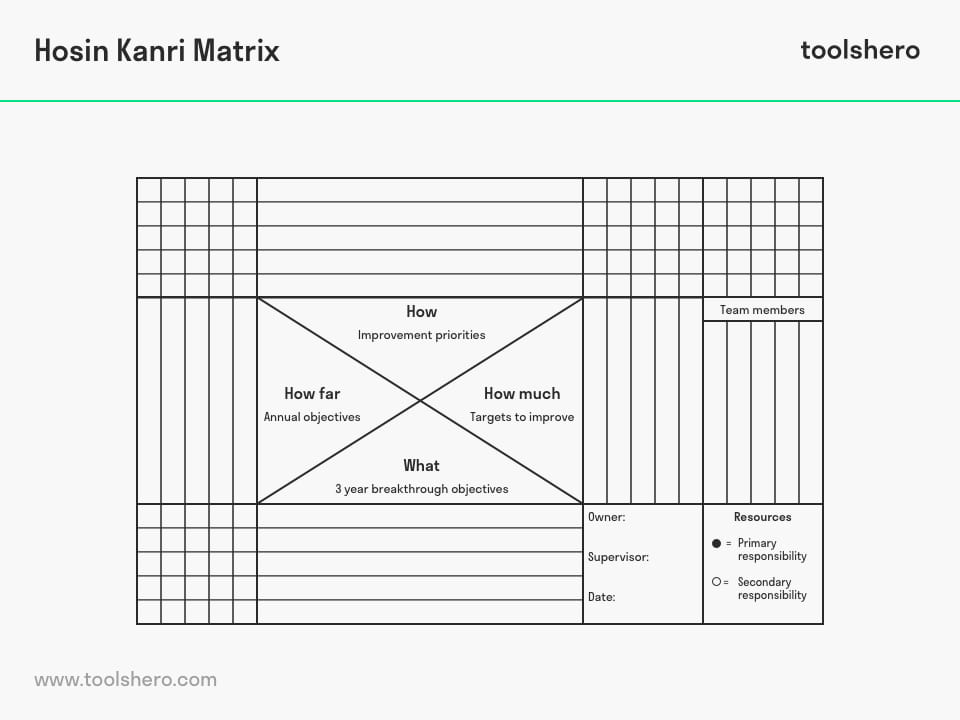
Figure 1 – Hoshin Kanri Matrix
The three year breakthrough objective would be to achieve 20% growth in international sales. Note how this is the starting point of the table. Recall Stephen Covey’s “start with the end in mind” and you can see how this is the beginning of the hoshin planning matrix.
If the company desires to grow by 20% over the next three years, it will not achieve this growth in year 1. On the left hand side of the chart, note that the year one growth is expected to be 5%. If the organization desires to achieve the 20% by year 3, then achieving 5% in year one would put them on track to be successful.
To achieve the growth in the first year, the company determines the improvement priorities that will make the sales targets attainable. They decide they need to identify five potential sales agencies. Once these have been identified, the company plans to partner with two of those agencies. Specific individuals are assigned, and they are tasked with implementing certain improvements. Each individual is then given a detailed action plan with the goal of contracting two sales agencies within a specified timeframe.
This example focuses on just one three-year objective. Typically, companies have 4–6 objectives. With more objectives, employees have to divide their attention among too many issues. The advantage of this approach is that everyone is aware of the overall strategic objectives, goals, and assignments.
This ensures the entire company is on the same page. In addition, the Hoshin Kanri matrix makes it possible to assign individual action items to people and hold them accountable for them. When an action item falls behind schedule, management can take measures to course-correct the organization and increase the likelihood of success.
How Does Hoshin Kanri Work? 7 Steps
The Hoshin Kanri method works by translating long-term goals, step by step, into concrete activities and measurable results. This creates a clear link between an organization’s strategy and its day-to-day work. The process also helps set priorities, assign responsibilities, and regularly check whether the organization is still on track.
In practice, Hoshin Kanri can be implemented using seven steps.
Step 1: Determine the strategic direction
The first step is to determine where the organization wants to go in the long term. This involves identifying the most important ambitions and challenges for the coming years. Examples include growth in a new market, improving customer satisfaction, or enhancing the quality of products and services.
A clear strategic direction helps in making decisions. After all, not every goal can be given the same priority at the same time.
Step 2: Formulate breakthrough objectives
Next, the most important long-term goals are translated into a limited number of breakthrough objectives. These are goals designed to bring about a clear change or improvement within the organization.
For example, an organization that wants to grow internationally might set a breakthrough goal of increasing international revenue by 20 percent within three years.
By limiting the number of breakthrough goals, the focus remains on the goals that are most important to the organization.
Step 3: Translate the goals into annual objectives
A long-term goal is usually not achieved within a single year. That is why breakthrough goals are translated into concrete objectives for the coming year.
For example, if an organization aims to grow by 20 percent within three years, a growth target of 5 percent can be set for the first year. This creates a measurable milestone that can be used to determine whether the organization is making sufficient progress.
Step 4: Determine improvement priorities
For each annual objective, the organization then determines which improvements or initiatives are needed to achieve the goal.
In the case of international growth, this might mean, for example, developing new sales channels, recruiting sales representatives, or entering into new partnerships.
The improvement priorities thus form the link between a strategic goal and the activities needed to actually achieve that goal.
Step 5: Assign Responsibilities and Create Action Plans
Once it is clear what needs to be done, responsibilities are assigned. Individuals or teams are assigned specific improvement activities and determine what actions are needed to carry them out.
These actions can be documented in an action plan. This plan includes, for example, the activities, responsible individuals, deadlines, and desired outcomes.
This clarifies who is responsible for what and how each activity contributes to the broader strategy.
Step 6: Implement the plans and measure progress
Once the goals and action plans have been established, implementation begins. During this phase, progress and the results achieved are regularly monitored.
Metrics and KPIs help determine whether a goal is being achieved according to plan. If results fall short, the cause can be investigated, and necessary corrective actions can be identified.
The Hoshin Kanri matrix can be used to track goals, activities, metrics, and responsibilities in a cohesive manner.
Step 7: Evaluate and Adjust
The Hoshin Kanri method is not a one-time planning activity. Progress is regularly evaluated to determine whether the chosen approach still aligns with the strategic objectives.
When circumstances change or results fall short, priorities and actions can be adjusted. At the end of a period, an assessment is also made of which goals have been achieved and what lessons can be carried forward to the next cycle.
This creates a continuous process of planning, executing, monitoring, and improving. Hoshin Kanri thus helps not only in formulating strategy, but above all in actually implementing and following through on it.
What is the relationship between Hoshin Kanri and the PDCA cycle?
Hoshin Kanri aligns well with the PDCA cycle. Both approaches are based on a continuous process of planning, executing, monitoring, and improving.
In Hoshin Kanri, strategic goals, priorities, and actions are first defined. These are then implemented, and metrics and KPIs are used to track whether the desired results are being achieved. If progress falls short or circumstances change, goals and actions can be adjusted.
The PDCA cycle supports this process by regularly assessing what is working, what could be improved, and what adjustments are needed. As a result, Hoshin Kanri is not a one-time strategic plan, but rather a recurring process of learning and improvement.
The combination of Hoshin Kanri and PDCA thus helps organizations not only to formulate strategy but also to systematically implement, evaluate, and further improve it.
What is Catchball within Hoshin Kanri?
Catchball is an important part of Hoshin Kanri and helps align strategic goals within an organization. Instead of simply passing down goals from the top, ideas, objectives, and possible actions are discussed across different levels and teams.
The name “Catchball” refers to the back-and-forth passing of a ball. Within Hoshin Kanri, this happens figuratively with proposals and ideas. For example, a goal may be proposed by management, after which a team assesses what is feasible, what resources are needed, and what adjustments are advisable. The results are then discussed again and refined.
This way of working creates more room for knowledge and experience from different parts of the organization. At the same time, it becomes clear whether a strategic goal is feasible in practice and what contributions from individuals or teams are needed to achieve it.
Catchball thus helps not only to communicate goals but also to collaboratively translate them into actionable agreements. This can lead to greater engagement, better coordination, and a stronger sense of ownership in the execution of the strategy.
Within Hoshin Kanri, Catchball thus serves as the link between setting the strategic direction and actually implementing it.
Hoshin Kanri Matrix template
Visualize the actions between your strategic plans and the goals with the Hoshin Kanri Matrix excel template, useful for both managers and employees.
Download the Hoshin Kanri Matrix template
For members only | Get instant access to the Hoshin Kanri Matrix template — plus unlimited access to 1,200+ expert articles and tools. Explore Membership Options
Benefits and Pitfalls of Hoshin Kanri
The Hoshin Kanri method helps organizations better align strategy and execution. The method clarifies which goals take priority, what actions are needed, and who is responsible for implementation. At the same time, Hoshin Kanri requires discipline and regular coordination to remain effective.
Benefits of Hoshin Kanri
A key benefit is that strategic goals are translated into concrete and measurable activities. This creates greater focus and clarifies how daily work contributes to the organization’s long-term direction.
In addition, the Hoshin Kanri method can foster greater alignment and ownership. By making goals, responsibilities, and progress visible, teams can collaborate more effectively and make adjustments more quickly when results fall short.
Pitfalls of Hoshin Kanri
A common pitfall is setting too many goals at once. This can lead to a loss of focus and make it harder to actually make progress.
The method can also become too much of an administrative exercise if the emphasis is solely on filling out the X-matrix. Without regular evaluation, Catchball, and course correction, its practical value remains limited.
Finally, it is important that goals are clear and measurable. When responsibilities are unclear or progress is not adequately monitored, there is a risk that the strategy will not be effectively translated into actual results.
Recommended books and publications on Hoshin Kanri
The Hoshin Kanri method helps organizations translate strategy into concrete goals, improvement priorities, action plans, and measurable progress. The method illustrates how long-term goals, annual goals, KPIs, projects, and responsible parties are interconnected. This creates greater focus, alignment, and ownership in the execution of strategy. The books and publications listed below provide additional insight into Hoshin Kanri, policy deployment, the X-matrix, Lean management, Total Quality Management, strategy execution, and continuous improvement.
- Akao, Y. (Ed.). (1991). Hoshin Kanri: Policy Deployment for Successful TQM. Cambridge, MA: Productivity Press. → Akao is a key foundational source on Hoshin Kanri and policy deployment. The book demonstrates how strategic goals can be translated into concrete improvement activities and how organizations can involve everyone in quality improvement and strategy execution.
- Akao, Y. (1990). Quality Function Deployment: Integrating Customer Requirements into Product Design. Cambridge, MA: Productivity Press. → This publication is relevant because Hoshin Kanri and Quality Function Deployment are both closely linked to Japanese quality philosophy. For the Hoshin Kanri Matrix, the process of translating abstract goals and customer needs into concrete actions and measurable priorities is particularly valuable.
- Dennis, P. (2006). Getting the Right Things Done: A Leader’s Guide to Planning and Execution. Cambridge, MA: Lean Enterprise Institute. → Dennis makes Hoshin Kanri practical for leaders and teams. The book aligns well with the Hoshin Kanri Matrix, as it demonstrates how organizations can link strategic goals, annual priorities, ownership, and the pace of progress.
- Jackson, T. L. (2006). Hoshin Kanri for the Lean Enterprise: Developing Competitive Capabilities and Managing Profit. New York, NY: Productivity Press. → Jackson describes how Hoshin Kanri can be used within Lean organizations. The source is relevant because the Hoshin Kanri Matrix is not just a fill-in-the-blanks template, but a way to connect strategy, process improvement, performance management, and leadership.
- Kesterson, R. K. (2014). The basics of Hoshin Kanri. Boca Raton, FL: CRC Press. → Kesterson offers an accessible and practical explanation of Hoshin Kanri. This book is suitable for readers who want to understand how breakthrough goals, annual goals, action plans, KPIs, and responsibilities come together in a single structured strategy process.
- Liker, J. K. (2004). The Toyota Way: 14 Management Principles from the World’s Greatest Manufacturer. New York, NY: McGraw-Hill. → Liker describes the management principles behind Toyota, including continuous improvement, respect for people, long-term thinking, and visual management. This is relevant to the Hoshin Kanri Matrix because the method fits well within Lean management and Toyota’s approach to strategic improvement.
- Melum, M. M., & Collett, C. (1995). Breakthrough Leadership: Achieving Organizational Alignment through Hoshin Planning. Milwaukee, WI: ASQ Quality Press. → This publication links Hoshin planning to leadership and organizational alignment. This is valuable for the Hoshin Kanri Matrix because the model is particularly powerful when leaders provide direction and actively involve teams in translating strategy into execution.
- Witcher, B. J., & Butterworth, R. (2001). Hoshin Kanri: Policy management in Japanese-owned UK subsidiaries. Journal of Management Studies, 38(5), 651–674. → Witcher and Butterworth examine Hoshin Kanri in Japanese subsidiaries in the United Kingdom. The publication is relevant because it demonstrates how policy deployment is used in practice to link strategic priorities, local execution, and organization-wide alignment.
- Witcher, B. J., & Chau, V. S. (2007). Balanced Scorecard and Hoshin Kanri: Dynamic Capabilities for Managing Strategic Fit. Management Decision, 45(3), 518-538. → Witcher and Chau compare the Balanced Scorecard and Hoshin Kanri as methods for managing strategic fit. This aligns well with the Hoshin Kanri Matrix, as both approaches help to better align goals, performance indicators, and strategic actions.
- Witcher, B. J., Chau, V. S., & Harding, P. (2008). Dynamic capabilities: Top executive audits and Hoshin Kanri at Nissan South Africa. International Journal of Operations & Production Management, 28(6), 540-561. → This case study demonstrates how Hoshin Kanri can be used for strategic audits and management at the executive level. The source is useful because it clarifies that the Hoshin Kanri Matrix is not only an operational tool but can also contribute to strategic agility and decision-making.
How to cite this article:
Lindell, J. (2015). Hoshin Kanri Matrix. Retrieved [insert date] from Toolshero.com: https://www.toolshero.com/strategy/hoshin-kanri-matrix/
Original publication date: August 25, 2015 | Last update: August 11, 2026
Add a link to this page on your website:
<a href=”https://www.toolshero.com/strategy/hoshin-kanri-matrix/”>Toolshero.com: Hoshin Kanri Matrix</a>